Saturday, February 9, 2013

Almdovar's Posters, or How I'm So Excited

Two new posters for Almodóvar's new film I'm So Excited have been released (via) but this colorful one is my favorite, if only because it screams Almodóvar.


It makes me want to have a gazpacho while being tied down to a bed as I'm being filmed to the tunes of old La Lupe songs. Or maybe cross-dress while disposing of a body before I head over to witness a penis-size contest in a nun's outfit. 

Inspired by Nat's usual posterized posts, I thought I'd revel in the pop-colored beauty that are his posters:

Pepi, Luci, Bom y otras chicas del montón (1980), Laberinto de Pasiones (1982), Entre Tinieblas (1983)

La Ley Del Deseo ( 1984), Matador (1986), La Ley Del Deseo (1987)

Mujeres al Borde de un Ataque de Nervios (1988), ¡Atame! (1990), Tacones Lejanos (1991)
Kika (1993), La Flor de Mi Secreto (1995), Carne Trémula (1997)

Todo Sobre Mi Madre (1999), Hable Con Ella (2002), La Mala Educación (2004)

Volver (2006), Los Abrazos Rotos (2009), La Piel Que Habito (2011)

I have seen all but Entre Tinieblas (Dark Habits) -- not for lack of trying, that one's hard to track down! -- and I can safely state that Pedro is my favorite working filmmaker. His filmography, though uneven (those first four films find him trying on different genres on for size, while his 1990s output was less than stellar though not without individual merits) is a wonderful gift. I love his films not only for giving Carmen, Antonio, and Penelope plenty to do as they honed their respective crafts, but for the visual panache and Almodovarian grammar we have come to enjoy. Whether it's with an ouroboros-like Noir, a melodramatic showcase of gifted actresses, or a lustful revenge sex-fantasy, Almodovar's films continue to thrill and excite three decades after his brash and colorful pop debut. And yes, I'm very excited about his new film. I mean, with this trailer, how can you not?

Wednesday, February 6, 2013

Django Unchained, or How Inglorious 2.0 (Slavery Edition) is a bloody mess


Django Unchained
Written & Directed by Quentin Tarantino
Starring: Jamie Foxx, Christoph Waltz, Leonardo DiCaprio, Samuel L. Jackson & Kerry Washington.

Oscar nomination: 5
Best Original Screenplay (Quentin Tarantino), Best Cinematography, Best Sound Editing, Best Supporting Actor (Cristoph Waltz), Best Picture


What to say of Quentin Tarantino's latest revenge fantasy set in the years before the Civil War and centered around ex-slave Django (Foxx)'s quest to rescue his beloved Bromhilda (Washington) with the help of a German bounty hunter (Waltz)? I'll say this, Tarantino knows how to score the hell out of a movie: Morricone's Ancora Qui is particularly haunting, quietly scoring the calm before the blood-splattered climax at Candieland. He also knows how to get visceral performances from his actors. This serves DiCaprio and Waltz quite well; the former relishes playing a dandy villainous role while the latter tweaks his charismatic yet ruthless take on Hans Landa to good effect. But the movie, both in its exploration of race relations through the prism of a spaghetti western and its success at offering actors a playful arena in which to let loose, wholly belongs to Samuel L. Jackson's cruel, and hammy Stephen. As Candie (DiCaprio)'s right hand man at his plantation, Jackson's Stephen is the epitome of what Tarantino's unwieldy movie seems to want to accomplish: to look deeply into the shameful past of slavery.  Stephen is the most despicable character in the film, not least because he is a character who perpetuates (and relishes) the very enslavement that keeps him tied to Candie. 

That Tarantino, in usual Tarantino-fashion, frames his film as a revenge fantasy following a cipher of a man who hopes to be reunited with his mostly-mute wife (Washington is given barely a personality let alone any dialogue) amidst a mostly entertaining shoot-em-up western is what makes it interesting in theory yet lacking in execution. Tarantino has several scenes that shine (Candie's phrenology-inspired outburst, Schultz's introduction) but overall the film feels not only too long but too often dragging. While the violence is at once more stylized yet less glamorized than in his past films, packing a punch especially because of the real-life violence they evoke (I'm thinking here of the dogs scene and the mandingo fight), it nevertheless reduces Django's quest less to the larger context of slavery than to the American individualized myth: Django and Bromhilda get their happy ending, even as the structure of slavery remains intact. In this sense, while the flair and subject matter of the film should harken back to Tarantino's own Inglorious Basterds, it is telling that while that 2009 film ended with the (albeit imagined) murder of the Fuhrer and his most trusted advisors, thus annihilating Nazi ideology both figuratively and literally, Django barely attempts to address the larger structural institution that enslaved the very characters that populate Tarantino's latest. C+

Monday, February 4, 2013

Beasts of the Southern Wild, or How Hushpuppy's bathtub puts a spell on you


Beasts of the Southern Wild
Directed by: Benh Zeitlin
Written by: Benh Zeitlin & Lucy Alibar
Starring: Quvenzhané Wallis & Dwight Henry.

Oscar Nominations:
4
Best Adapted Screenplay (Benh Zeitlin & Lucy Alibar), Best Actress (Quvenzhané Wallis), Best Director (Benh Zeitlin) & Best Picture.

The little Sundance film that could is the most improbable Best Picture nominee (give or take a Haneke French-language film) but that is a testament to the wondrous spell this magical realist take on post-Katrina puts on you. Most of that is due to the central firecracker of its protagonist. As we hear in her own voice-over: "There once was a Hushpuppy who lived with her Daddy in the Bathtub." Her confident voice, paired with her expressive face and resilient body make her a thrilling character to follow as she grapples with an aloof but loving father, a flooded household, the promise of her mother's return and the prospect of a fateful visit from some fanciful Wild Things. Quevenzhané is a great find; her Oscar nomination, while thorny in that it rewards what is mostly an inhabited performance enhanced by her voice-work and Zeitlin's direction, is nonetheless a testament to her presence on screen. As Hushpuppy, she is preternaturally insightful; a child who knows she's only got herself in times of need, even when her boozy (and frighteningly if sporadically violent) father attempts to safeguard her. Drenched in the muggy world of the Bathtub (a mythical stand-in for the outskirts of New Orleans, which grounds the film in a concrete socio-cultural milieu), Zeitlin's film is at once a naturalist tale of an independent and charming child and a whimsical fable of a population forgotten. B+

Saturday, February 2, 2013

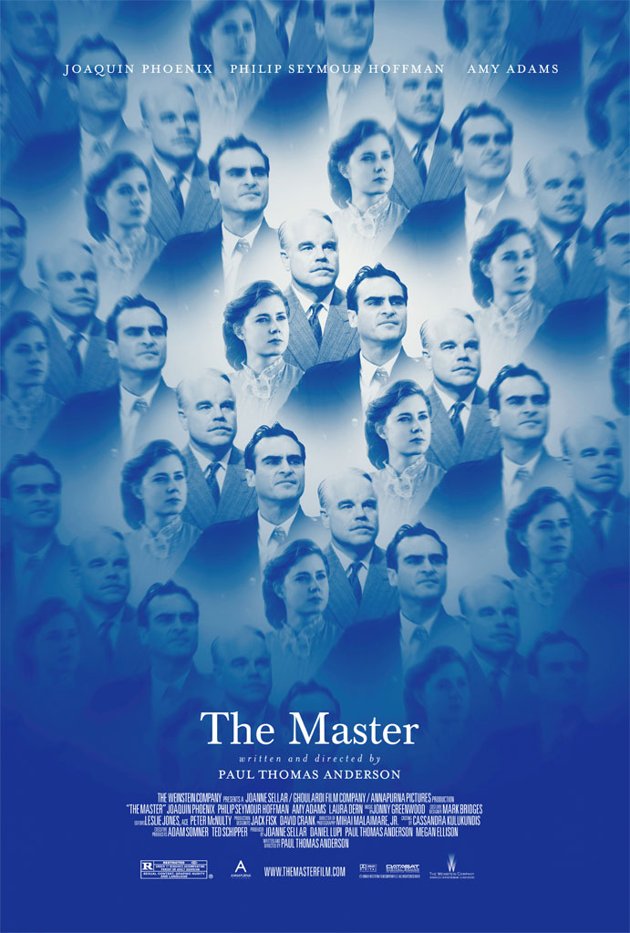
The Master, or How PTA's Rorschach is spell-binding


The Master
Written & Directed by: P. T. Anderson
Starring: Joaquin Phoenix, Philip Seymour Hoffman, Amy Adams & Laura Dern.

Oscar Nominations: 3
Best Supporting Actor (Philip Seymour Hoffman), Best Supporting Actress (Amy Adams) & Best Actor (Joaquin Phoenix)

Few films baffled and challenged me more than Paul Thomas Anderson's cryptic The Master. Shot beautifully in 70mm, the film's opaqueness almost presents itself as a Rorschach test to its audience, not unlike the one featured early on as we meet Freddy (Phoenix). While the film clearly tackles issues of cult-like faith in the figure of L. Ron Hubbard-lookalike Lancaster Dodd (Hoffman), the film to me felt to me as the most searing look at post-war American masculinity I had seen on screen in a long time. As Naval-veteran Freddy, Joaquin Phoenix creates an amalgam of the post-war American male. Contorted in posture, crippled by unbridled lust and dangerously aimless, Freddy moves from job to job after coming back from fighting only to find himself stranded aboard the Dodd's boat. What follows is the improbable (albeit platonic) romance between Freddy and Dodd as the latter takes the former in as his disciple, intent on curbing Freddy's animal impulses and prove the efficacy of his own teachings. Following There Will be Blood, this is an important chapter in Anderson's continued interest in deconstructing the myths that make up the United States.

Anderson's meditative film is best experienced rather than described. Its dianetics-influenced structure of probing questions and unintelligible answers proves frustrating at times, but it is worth a dizzying gander. A-

Thursday, January 31, 2013

RIP 30 Rock, or How Long Live 30 Rock

Shut up everyone, shut up Lutz! My favorite sitcom of all time ends tonight and I wanted to take a second and thank its creator:

Thank you Tina Fey...

For giving me two Black Swans,

For your obsession with Star Wars ("I don't think it's fair for me to be on a jury because I'm a hologram")

For making me want to go to there, 

For teaching me tuxedo etiquette ("It's after six Lemon, what am I a farmer?")

For Bijou ("Call us in English, German or Polish")

For giving Jane plenty to sing ("My muffin-top is all that")

For Sabor de Soledad ("Ahora con mas semen de toro!")

For life-long advice ("Never follow a hippie to a second location")

For Mickey Rourke jokes ("I'm going to have to break you down and build you back up, just like Mickey Rourke did to me sexually")

For the alternate Liz Lemons (with or without Seinfeld money),

For MILF Island (and erection cove),

For Queen of Jordan ("Rude!"),

For Homonym ("Nope. It's the other one!")

For the Rural Juror ("Roar her gem her?")

For el Generalissimo ("You are... surprisingly gay")

For Kenneth's Sydney-Bristowing ("I'll use my sexuality as a weapon!")

For Joker Liz ("I AM sick, sick like a fox!")

For fat Jenna ("It's visual trickery!")

For "Hard to Watch, based on the book Stone Cold Bummer by Manipulate"

For Abby Flynn ("I'm a very sexy baby!")

For Colleen Donaghy ("You give me ten minutes with the Lemon family and I'll have them tearing at each other like drag queens at a wig sale")


For D'Fwan ("D'fwink responsibly")

For devilishly gay Devon Banks ("If there's one thing I learned from you Jack is keep your friends close... and your enemies so close, you're almost kissing")

For Dr Spaceman ("Erectile disfunction, is not just a dog problem anymore")

For Werewolf Bar Vitzvah ("Boys becoming men, men becoming wolves!")

For Jacks's romantic interests ("Who is number one on your speed dial?"/"I have hollow bones"/"You know I love my Big Beef and Cheddar!"/"I'll try. Wicked hard."/"'It' meaning 'business'"/"You will never see the crazy underwears I have on!")

For Lemon's romantic interests ("What you're too good for me now that I have pirate hands?"/"Hey dummy!"/"Can I get another salmon compadre?"/"Question about Lando Calrissian: is that an Armenian name?"/"Velocipede"/"Kimiko-san"/"I will WASTE you!")


... I could go on (I haven't even mentioned "Apollo Apollo", Greenzo, Shanice, Kaylee, Jeffrey Wienerslav, Argus, Prince Gerhart, Borpo, Jackie Jormp-Jormp, Verna, Angie, Jenna-Side.com, Frank's hats, Christmas Attack Zones, Reaganing, Lizbeanism, EGOTing, double-edge swords, female fight clubs, Sims Families that keep getting murdered, potentially harmful eye-rolls, robot-penises, shameful cookie jars, (meat) lovers (pizza), cheesy-blasters, night cheeses, slankets, Ludachristmas, Criss points, micro-naps, McFlurrrries, came-rahs, strides of pride, Sandwich days, Shark Weeks, Alfie & Abner, Dratch-as-Liz-Taylor, Anna Howard Shaw Day, paintings of horses, Kim Jong Il...)

But most of all, thank you for a wonderfully zany and cleverly irreverent sitcom that not only played to my pop culture loving personality ("You Solo-ed me!") but nurtured it ("Blerg" "What the what?!" "Who's got two thumbs, speaks limited French and hasn't cried today?" "This is not toward!" "HAM!" "Listen up fives, a ten is speaking!" "Nerdz!" "Charles-what-now?" "Me want food!").

Tonight, Fey & co. are shutting it down. We will be saying "Good Peacock!" and waving (like a human!) to the show. But it okay, don't be cry.

I will always treasure the laughs and the tears (from the laughs) Fey & co. offered me through these past seven seasons and nary a week will pass without me revisiting one of their crazy shenanigans. Here's hoping Jack, Liz, Tracy, Jenna and Kenneth go to sitcom heaven high fiving a million angels!

Lemon out!

Wednesday, January 30, 2013

Flight, or How not even Denzel could land this thing


Flight
Directed by: Robert Zemeckis
Written by: John Gatins
Starring: Denzel Washington, Kelly Reilly, John Goodman, Don Cheadle & Melissa Leo.

Oscar Nominations: 2
Best Original Screenplay (John Gatins) & Best Actor (Denzel Washington)

Flight opens with a plane crash-landing sequence that is riveting, expertly crafted and ultimately the film's undoing: nothing ever quite lives up to it. Following pilot Whip Whitaker (Washington) as he drunkenly -- if masterfully -- lands a troubled plane, going so far as to steer it upside down, Zemeckis and Gatins set the scene for a story of an addict faced with improbable survival. A savior in the eyes of the media, his addiction quickly establishes him as the potential scapegoat for the airline which faces a branding catastrophe should it accept full blame on the plane's crash. Yet this legal battle feels like window-dressing once it's clear the film is more interested in the personal demons that haunt Washington's Whip.

We have seen this alcoholic-trying-to-sober up story time and time again yet other than a charmingly biting scene at the hospital staircase (courtesy of James Badgley Dale's cancer-stricken character), the film never quite achieves the high-wire act of bringing together faith, addiction and duty, coming off instead as a glossier Lifetime movie of the week. The insurance problems, the high-stakes hearings (which feature the other standout of the film, Melissa Leo) and the airline backdrop attempt to raise the stakes but ultimately the step-and-repeat structure cripples any suspense. When we see a close-up of a mini-bar bottle of vodka, any tension is dissipated by the fact that the scene plays out just as one would expect. At that point, Gatins and Zemeckis hope I'm rooting for Whip yet looking at what's on the screen, we are not given much to root for. Instead, much of the film heavily relies on Washington's own charisma to elicit our own empathy. Several shots of him walking indoors with his shades indoors wish to marry the cool-cat attitude of Washington-the-star with the miserable and hungover feeling of Washington-as-Whip. Sadly, not even Washington's star persona (which, disclaimer, has never smitten me) can keep this film from crashing into its own cliches. C

Monday, January 28, 2013

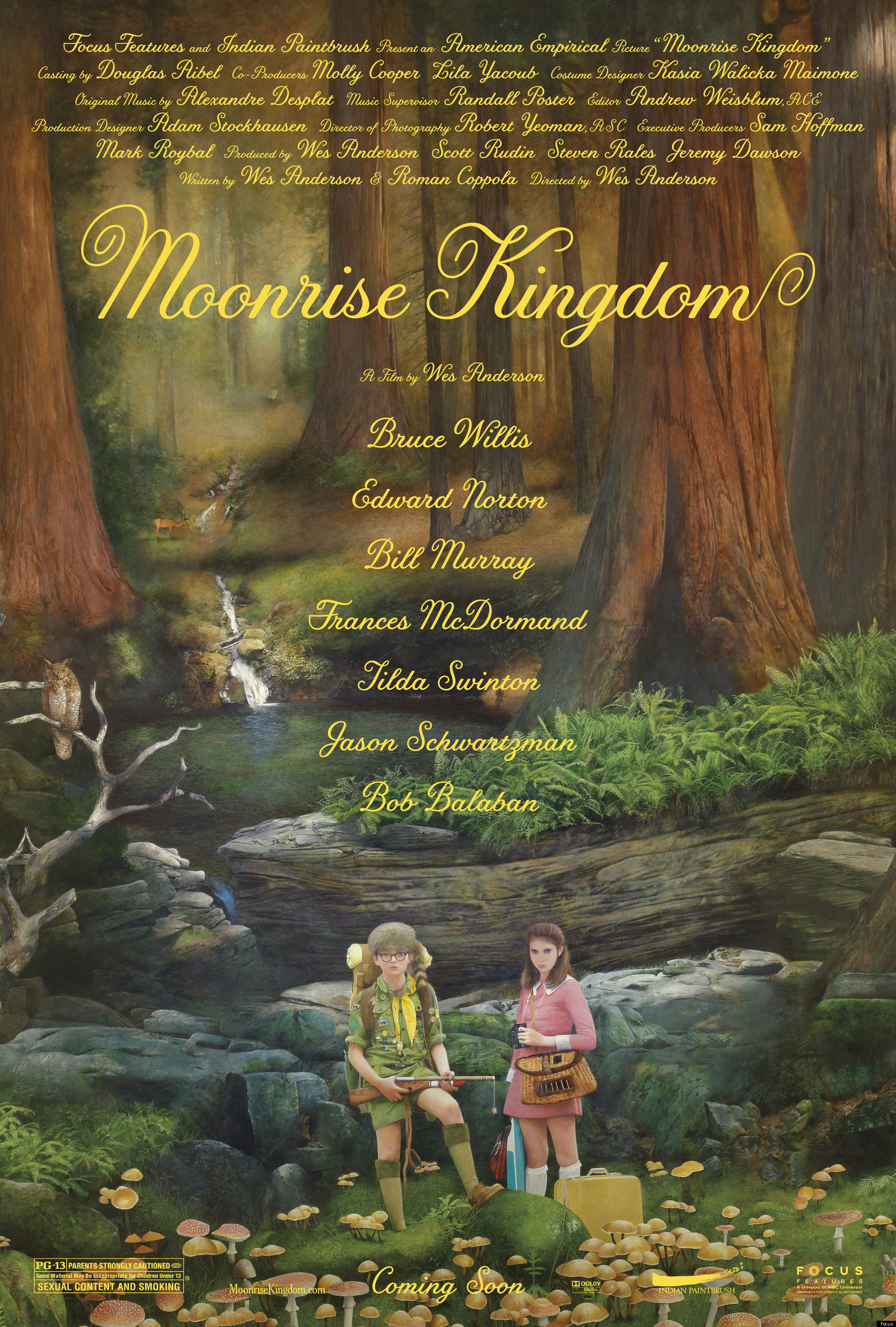
Moonrise Kingdom, or How Anderson's twee-love story is gorgeous and affecting


Moonrise Kingdom
Directed by Wes Anderson
Written by Wes Anderson & Roman Coppola
Starring Jared Gilman, Kara Hayward, Bruce Willis, Frances McDormand, Tilda Swinton, Bill Murray, Edward Norton & Bob Balaban.

Oscar Nominations: 1
Best Original Screenplay

The scene: A beach on the New England coast. A portable record player blares a fittingly titled song "Les Temps de l'Amour." A boy and a girl, both in their underwear, begin awkwardly yet endearingly dancing to this playful tune. Deciding to slow dance, they turn to each other and kiss primly on the lips. This escalates to fumbling french kisses, over-the-bra touching and ends with the two laying side by side on a makeshift Khaki Scout tent.

This scene epitomizes the mix of child-like wonder and burgeoning teen desire that permeates the film. Aesthetically, Anderson uses his knack for making the world into a primrose-colored tableau-vivant to envelop the romance between introvert Sam (Gilman) and Suzy (Hayward) with a hint of fantasy. Sam and Suzy's romantic escapade throws into relief the very infantile adult world around them which includes an unhappy marriage, an illicit affair and a bumbling scout leader. That Sam and Suzy are never reduced to the grating precociousness of cinema kids is both a testament to Anderson's smart script and his nuanced child actors. Despite its jejune art direction -- which aims for a storybook feel -- Anderson's film never stoops to the condescension that is usually directed at these coming-of-age protagonists. That it is the adults who find themselves entangled in juvenile antics yet committed to the responsibilities of their age deepen Anderson's wistful look at Sam and Suzy's epistolary (and later runaway) love story. Filled throughout with Anderson's signature droll humour and visual flair, Moonrise Kingdom is a lovely film about the joys of love and the heartbreak of growing up. A