Showing posts with label 2012 films. Show all posts

Sunday, February 24, 2013

Lincoln, or How Kushner's drawing room talky is riveting


And so it comes to an end. See all the rest of the nominated films reviewed here or by following the tag. I am excitedly baking, preparing for my annual Oscar-themed cupcake party, so despite my allergy to everything Seth McFarlane, I am hoping it will be a good night. If nothing else, we'll have Adele singing "Skyfall" and maybe a nail-biter of a night in key categories which always makes for a fun and exciting ceremony. See you on the other side!

Lincoln
Directed by: Steven Spielberg
Written by: Tony Kushner
Starring: Daniel Day-Lewis, Sally Field, Tommy Lee-Jones, Joseph Gordon-Levitt, James Spader & John Hawkes.

Oscar Nominations: 12 (Nominations leader!)
Best Original Score (John Williams), Best Sound Mixing, Best Production Design, Best Costume Design, Best Cinematography, Best Editing, Best Adapted Screenplay (Tony Kushner), Best Supporting Actor (Tommy Lee Jones), Best Supporting Actress (Sally Field), Best Actor (Daniel Day-Lewis), Best Director (Steven Spielberg) & Best Picture.

The subject matter (and even its marketing) suggested Spielberg's Lincoln would be stuffy, if exhaustively researched, history lesson on the passing on the thirteenth amendment. That's not really fair nor very accurate. Kushner's script manages to make Lincoln's attempts at abolishing slavery, ending the Civil War, draft a course for reconstruction, maintain some sort of familial stability (not necessarily in that order) while ideologically trying to keep a spirit of bipartisanship that upholds the even then dusty and ambiguously worded constitutional principles, a terse and at times electrifying film. This is obviously due to the assembled cast with Daniel Day-Lewis as the eponymous president whose Lincoln may not be quite the thespian achievement that Daniel Plainview was (though boy do these two performances make for quite an Americana double-bill!) but it is nonetheless a triumph in the way it humanizes Lincoln without losing the albeit hagiographic portrait the film paints. In his hands, Kushner's dramaturg soliloquies feel less stilted and stagey than they should.

The backdoor politics that make the central plot are quite gripping and timely, and it is only as the film enters its third act that a certain Spielbergian treacly ending (sprinkled with a necessary if overblown sense of embodied American exceptionalism) that it lags, though Jones's final pleas and tender final scene light up this purposefully dusty chamber piece. A-

Saturday, February 23, 2013

Oscar Predictions, or How here goes!

Presented without commentary because, well, other than a couple of hunches and/or hopeful hunches (Zero Dark Thirty in Original Screenplay, Frankenweenie in Animated Feature) these mostly are the usual suspects. We'll check tomorrow to compare scores:


Friday, February 22, 2013

Life of Pi, or How Lee's Poetic Fable is a Beauty


Life of Pi
Directed by: Ang Lee
Written by: David Magee
Starring: Suraj Sharma, Irrfan Khan & Rafe Spall.

Oscar Nominations:
10
Best Original Song ("Pi's Lullaby"), Best Original Score (Mychael Danna), Best Sound Editing, Best Sound Mixing, Best Visual Effects, Best Production Design, Best Cinematography, Best Editing, Best Adapted Screenplay (David Magee), Best Director (Ang Lee) & Best Picture.

Having directed a broody Hulk blockbuster, a literary costume drama, a lustful period piece, a dazzlingly choreographed martial arts epic and a tender cowboy love story, Ang Lee has never met a cinematic challenge he hasn't tackled. That's not to say all of those have been home runs, but if anyone was going to tackle the heady challenge of bringing Yann Martel's spiritual tale of a boy stranded at sea with a tiger, you need not have looked further than Lee. The result is a visual wonder -- not only do Lee and his DP (Claudio Miranda) give you enough tableau-ready shots that take your breath away in their gorgeous simplicity, but they manage to find a kinetic energy to several sequences that nicely break away from what could very well have been a static and dull series of shots of a boy in the middle of the ocean. The film opens with an old man telling a young writer about his improbable story of survival: after his father decides to sell his zoo and move to Canada, a shipwreck leaves (Pi, short for Piscine) stranded in a lifeboat with a tiger, an orangutan, a zebra and a hyena. What follows is Pi's fantastical journey. If you're already groaning at the setup, then clearly Lee's seafaring film is not for you, especially as the last scene in the film will offer a more grounded, if much less satisfying, version of what you've witnessed.

The framing device, here deployed much less successfully than in the book drags the narrative and character momentum that Lee brings to the set pieces aboard the lifeboat, yanking us out of the action in order to offer some platitude about survival via voice-over or a Sorkin-type walk-and-talk somewhere in Canada. Nevertheless, Lee's film is visually stunning and a technical marvel (the tiger Richard Parker alone is enough to warrant a viewing) that makes what otherwise be an insufferable spiritual parable into a compelling film. B/B+

Wednesday, February 20, 2013

Les Miserables, or How no, I don't even want to hear the people sing


Les Miserables
Directed by: Tom Hooper
Written by:
Starring: Hugh Jackman, Russell Crowe, Anne Hathaway, Amanda Seyfried, Eddie Redmayne, Helena Bonham-Carter & Samantha Barks.

Oscar Nominations: 8
Best Original Song ("Suddenly"), Best Sound Mixing, Best Costume Design, Best Production Design, Best Make-Up & Hairstyling, Best Supporting Actress (Anne Hathaway), Best Actor (Hugh Jackman) & Best Picture.

I have already aired some of my larger problems with the film and thus won't rehearse those here. Instead I'll just say that, as directed by Hooper, Les Mis attempts to zero in on the emotional intimacy of the piece at the expense of the very epic nature of its source material. Uneven in its casting (for every Anne Hathaway nailing an iconic "I Dreamed a Dream" there is a Russell Crowe mostly underwhelming in a dull "Stars") and incapable of letting the material (or its actors) breathe, the film suffocates its strongest moments in an otherwise overblown production. C-

Monday, February 18, 2013

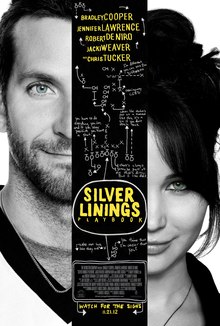
Silver Linings Playbook, or How the romantic comedy gets the runaround


Silver Linings Playbook
Written & Directed by: David O. Russell
Starring: Bradley Cooper, Jennifer Lawrence, Chris Tucker, Robert DeNiro & Jacki Weaver.

Oscar Nominations: The Big 8!
Best Editing, Best Adapted Screenplay (David O. Russell), Best Supporting Actor (Robert DeNiro), Best Supporting Actress (Jacki Weaver), Best Actor (Bradley Cooper), Best Actress (Jennifer Lawrence), Best Director (David O. Russell) & Best Picture.

In David O. Russell's Silver Linings Playbook, he has concocted a searing attack on romantic comedies. Or, at the very least, an indictment of both the characters they usually portray and the audiences that flock to them. How else to explain the fact that he makes the leads in this contemporary screwball comedy a pair of -- not to trip over words -- mentally ill characters? While I wonder if there's an interesting argument to be made about medication and mental healthcare in the film -- that aspect seems to disappear inexplicably halfway through the film -- I do think Russell has something to say about what usually see in a romantic comedy. Namely, people who don't function within socially-agreeable and -agreed-upon parameters. Isn't that the suspension of disbelief all romantic comedies require of us? That a lead character (and his audience) believes that if he just gets his shit together he will get his wife back regardless of what he did in a climactic third act (usually something big enough to warrant her scorn if not her outright disgust). Of course, this is where Russell's film begins. We are introduced to Pat Solitano (Cooper) as he attempts to return to 'normalcy' after a stint in a mental institution. He's thinner now than he was before when he assaulted his wife's lover upon finding them sharing a shower, but he's convinced he's better and wants nothing else than to patch up his marriage and find the silver lining in all of this that the title promises. Pat's delusions are presented precisely as that, even as the structure of romantic comedies dictate that he should overcome outward perceptions to win her back (an ending Russell's own film toys with, not without irony, of course).

But Russell's film is more interested in finding for Pat a calming presence (another trope in romantic comedies) and it makes sense that Tiffany (Lawrence) would be just as much of a mess as he is. David noting the Hepburn connection is pretty astute, especially as it betrays the very tropes the film wants to play with: Tiffany is not only a modern screwball protagonist, she is its limit-case. The trick comes when the upended tropes become necessary for the film to move forward. It's no surprise that the third act is as inevitable as it is blandly enjoyable. Ultimately, Russell's game cast can't lift what is a rather (intentionally?) messy film that straightens itself out only to end up where we all knew it eventually would, without much of a payoff. Unless of course, what we're supposed to draw from all of it is that romance is its own kind of anti-depressant? B

Sunday, February 17, 2013

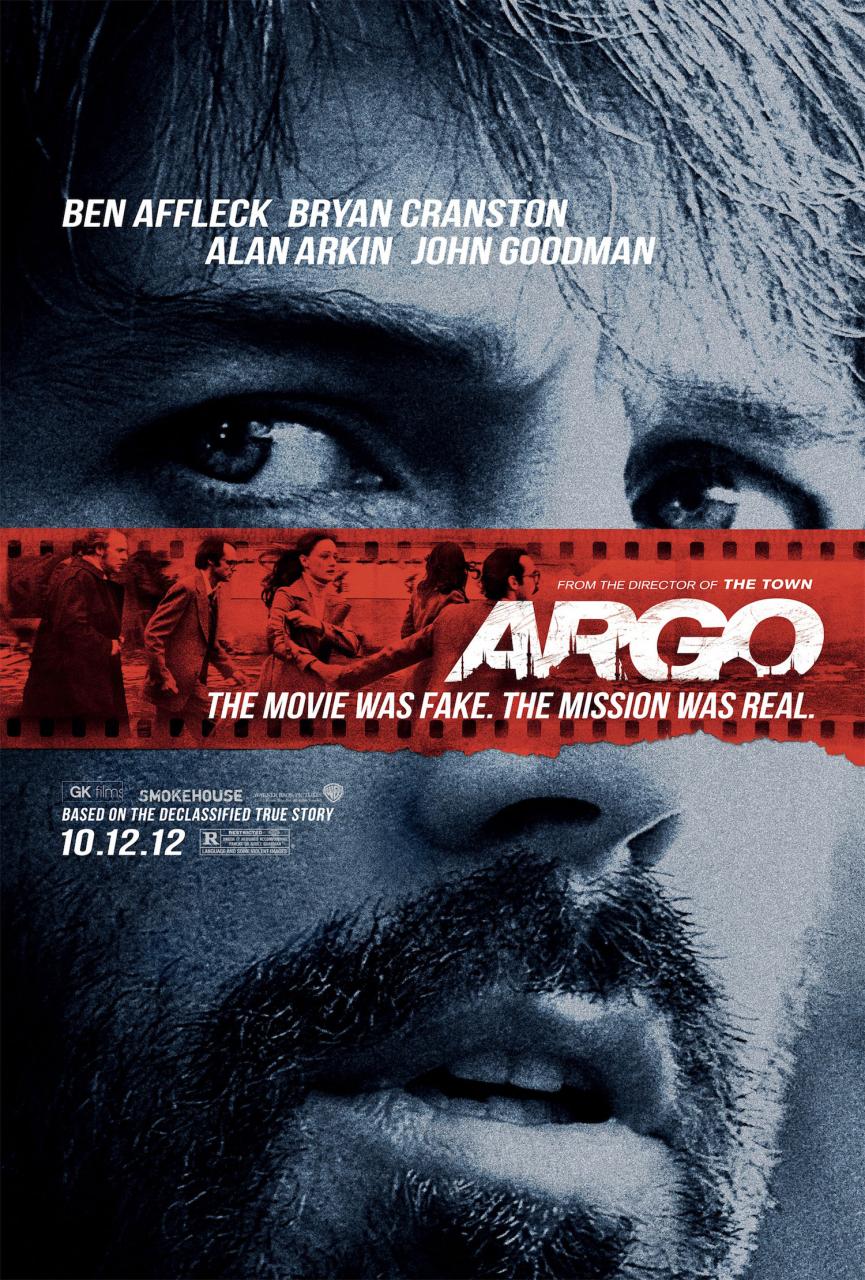
Argo, or How Hollywood can save the day AND be entertaining while doing so


Argo
Directed by: Ben Affleck
Written by: Chris Terrio
Starring: Ben Affleck, Alan Arkin, John Goodman, Bryan Cranston & Kyle Chandler.

Oscar Nominations: 7
Best Sound Mixing, Best Sound Editing, Best Original Score (Alexandre Desplat), Best Editing, Best Adapted Screenplay (Chris Terrio), Best Supporting Actor (Alan Arkin), Best Picture.

If nothing else, Ben Affleck's lively film about the preposterous (and yet true!) CIA plan to extract six Americans from Iran during the 1979 embassy hostage crisis through a so-crazy-it-works plan to pose as a film crew, has by far the best catch-phrase of all the Best Picture nominees. Say what you will about Arkin and Goodman (both playing versions of their own personas to varying degrees of success), but their recurring joke of "Argofuckyourself" is unmatched in an otherwise sober lineup (give or take a Russell dramedy).

What Argo definitely is is an entertaining film. Much of this is due to the brisk screenplay by Terrio and Affleck's ensemble. From the old-school Warner Bros. logo that greets the screen during the opening credits (yes, the same one used by Soderbergh's similarly throw-back stripper drama), Affleck places us squarely not only in the 1970s of the film, but in the 70s-style feel of the mainstream adult-dramas that the decade produced. This isn't surprising as Argo -- much like last year's Oscar winner The Artist -- is enchanted by Hollywood. Billing itself as "based on a declassified story," the film follows a CIA agent (Affleck) concocting a so-crazy-it-might-just-work plan to retrieve a group of six hostages being safe-guarded by the American embassy in Tehran by posing as a film crew. For this he enlists the help of a has-been producer (Arkin), a make-up artist (Goodman) and the three proceed to try and muster funding for the awfully camptastic sounding "Argo." Whether they'll be able to pull this off is the ticking clock suspense that fuels the entire film, and Affleck does a good job of keeping us entertained, ably grounding the pulse-pounding thriller elements of the film with a bevy of seasoned character actors (Garber, Donovan, Cranston, Ivanek, Chandler, Pill, Vand). It is obviously a foregone conclusion where the film is headed, but it's quite a thrill-ride getting there, from the zippy dialogue between Arkin and Goodman to the tender moments in the ambassador's house and the nail-biting scenes at the airport at the end. A-

Saturday, February 16, 2013

Motifs in Cinema (2012), or How films worked it last year

Motifs in Cinema is a discourse across 22 film blogs, assessing the way in which various thematic elements have been used in the 2012 cinematic landscape. How does a common theme vary in use from a comedy to a drama? Are filmmakers working from a similar canvas when they assess the issue of death or the dynamics of revenge? Like most things, a film begins with an idea - Motifs in Cinema assesses how the use of a common theme across various films changes when utilised by different artists.

I'll be looking at Work & the Workplace in four films released in 2012.

A strip joint. A bedroom. An arcade game. An undisclosed CIA

If these don't seem like run of the mill workplaces, it is because since TV has strengthened it's stronghold on hospitals, courtrooms, police headquarters and even ad agencies, it seems Hollywood has stretched its reach to explore a wider variety of workplaces. While I could wax on about the political board rooms of Washington in Lincoln, the high-stakes financial world of Arbitrage, the covert lair of spies of Skyfall or even the futuristic & dangerous gig of the loopers in, well, Looper, I opted to look instead at four films that gave us instances where characters found themselves at once defined by but also strengthened by their work, however ambiguously their relationship to it was. Of the four films I picked, I found a good enough cross-section of decidedly American visions of work and the workplace: from the deterministic world of Wreck-it Ralph (you are your job), to seeing a job as a means to an end (Mike who imagines a world where he needn't be "Magic" all the time).


Magic Mike (Steven Soderbergh)Was there any mainstream movie more insidiously interested in the ways the economic meltdown affected small town business than Soderbergh's stripper flick? Following the eponymous Mike (Channing Tatum), Soderbergh's film eschews the gratuitous take on strippers that its marketing suggested to construct instead a look into the bleak -- though arguably skintastic -- world of Florida male strippers. Mike's desire to leave the lucrative world of stripping is pit against the greed of both his boss Dallas (Matthew McConaughey) and his young protege Adam "the Kid" (Alex Pettyfer), both of whom represent a vision of the Xquisite bar as less of a workplace and more of a soul-crushing lifestyle -- though Soderbergh's lens doesn't quite come down as hard on it as my sentence suggests. Indeed, while the film begins with images of backstage camaraderie, we are quickly presented with a world that values bodies and workers as solely money-bringers with expiration dates. While Dallas imagines a future that continuously recycles itself, never changing anything more than the bodies and venues around him, Mike's entrepreneurial (and industriously artistic) vision is presented as ideal yet delusional (the bank scene dashes any hopes of our hero making good on his promising clothed career). Soderbergh's film is an attempt to show how hard it is to work it when all you're asked to do is flaunt it to get it.


The Sessions (Ben Lewin)There are many things I loved about this summery comedy focusing on the sexual blossoming of Mark (John Hawkes), a man living in an iron lung. That the bedroom is both Mark's "workplace" (wherein he writes with a pencil in his mouth the article that would in turn inspire the film we're watching) and Cheryl's (Hunt's sex surrogate character), is a subtle one I noticed only when I started thinking about it for this piece. Indeed, of the four films I chose to focus on, I believe it is the one that more sensitively treats the ways our personal lives can be enriched (and, of course, hampered) by our jobs. As I noted in my review, while the film skirts with the idea of pairing Cheryl and Mark as romantic foils, it never wants to diminish what Cheryl does as a sex surrogate. Her integrity is what eventually leads her to walk away (almost without getting her full payment for services rendered) even after the public/private, work/intimacy lines have been blurred. If nothing else, The Sessions's depiction of Cheryl's work as a sex-surrogate, treated with such compassion and candor, makes the film worth watching despite the preconceived notions of what the film is about. As Cheryl reminds us early on, she's not a hooker, though it does seem she has a heart of gold.


Wreck-it Ralph (Rich Moore)
When you think of Disney's zany animated feature, you'd be hard pressed to not realize that despite its individualistic and seemingly self-asserting motto (Ralph, the villain of the Fix-it Felix game, learns to cope with the lesson that "I am bad, and that is good. I will never be good, and that's not bad"), the film creates a pseudo-Marxian, if not outright Marxist, call to understand one's work (in this case, arcade game villainy) as not only pre-determined but deservedly so. Belonging to a different Disney film, Lumiere's "Life is so unnerving, For a servant who's not serving" kept ringing through my ears as we saw Ralph wanting to break out of his mold, only to learn that his wrecking is necessary for the world of Fix-It Felix and the Nicelanders to continue prospering. Unwittingly, the film presents Ralph's work and workplace as part and parcel of his personality. He has been, quite literally, programmed to wreck. If seeing an animated film as an allegory for the type of capitalism that wishes to keep unskilled workers in their status quo is a stretch, well, then I don't know what else I'm supposed to get out of a film that so clearly delineates its characters by what they do rather than who they are. Wherever he is, he's gonna wreck it!


Zero Dark Thirty (Kathryn Bigelow)
Hands down one of my favorite films this past year, Bigelow's film is obsessively
constructs in Maya (Jessica Chastain) a cipher of a character whose behavior (if not outright personality) is so heavily tied to her work, that Boal, Bigelow and Chastain offer us little to no information about her life outside of her work hunting Bin Laden at the CIA. The critical last lines of the film ("Where do you want to go?") are decidedly left unanswered. Maya exudes and is her job, yet the film doesn't present this as an unabashedly positive ideal, nor does it condemn it. Boal's script invites and creates these grey areas, so that while one of the characters suggests that Maya should be more social, we understand why she wouldn't. Maya's first line already speaks to the thorny negotiations that her work and workplace brings up. "You can help yourself by being truthful" shows her acknowledging and immediately shunning the motherly type her gender unnecessarily elicits in the people around her, while showcasing the way her impassiveness is not merely a pose. Thus, it is not surprising that Maya never wields her gender as a necessary weapon or a shield during the scenes of unashamed sexism scattered throughout the film. She is after all, not only (or just) a woman, but "the motherfucker" who found him.

All in all, these films, I hope, have shown that American filmmakers are interested in tackling the ever-vexing question of "Are you defined by your job?" in plenty of interesting ways, never wishing to see it as a foregone conclusion, nor letting a resounding "Yes" seem anything less than a reasonable answer. 

Thursday, February 14, 2013

Amour, or How a tender-hearted story gets refracted through Haneke's cruel lens


Amour
Written and Directed by: Michael Haneke
Starring: Emmanuelle Riva, Jean-Louis Trintignant & Isabelle Huppert.

Oscar Nominations: 5
Best Foreign Language Film, Best Original Screenplay, Best Actress (Emmanuelle Riva), Best Director (Michael Haneke) & Best Picture.

Despite the movie's title, I'd be hard-pressed to argue that "love" is indeed what is at the heart of this clinical dissection of the toils of aging seen through a Parisian couple. That is not to say that the couple at the center of the film (played heartbreakingly by Riva and Tritingnant) do not love one another. On the contrary, it is George's love for Anne which leads him to take care of her as she unravels into a near-vegetative state. Yet, at Haneke's hand, the film feels like a surgical look into the heart; cutting, exacting, accurate yet all too lethal (both to its characters and viewers). Love, the film argues, is not as glamorous as one imagines, but it is both painfully mundane and mundanely painful. It comes as no surprise that Haneke's touch thankfully doesn't let his two-hander fall into treacly territory. The first half hour is intent on establishing a sense of routine before the onset of the inevitable downward spiral that arrives alongside Anne's multiple strokes. The film is admirable in that it doesn't create in Anne a victim or a saint -- one of my favorite scenes in the film has to do with a former piano student of hers visiting, where she's forced to confront his dull condescension, only to be followed by a dispiriting realization of how she's being perceived.

Anne's disintegration is hard to watch, especially given Riva's presence which imbues her with a tender fragility that frustrates rather than ingratiates her to her husband and ourselves. The claustrophobia and complacency of the stolid Parisian apartment serves the film well as it unravels into its third act with a rather ambiguous denouement. The final moments of the film -- epitomizing the film as a whole -- vacillate between the sentimentality the set-up implies and the cruelty which Haneke infuses into his mise-en-scene, leaving us aghast and astray once the end credits roll. A

Tuesday, February 12, 2013

Zero Dark Thirty, or How Bigelow & Chastain kick ass


Zero Dark Thirty
Directed by: Kathryn Bigelow
Written by: Mark Boal
Starring: Jessica Chastain, Jason Clarke, Jennifer Ehle, Mark Strong, Joel Edgerton & Chriss Pratt.

Oscar Nominations: 5
Best Sound Editing, Best Editing, Best Original Screenplay (Mark Boal), Best Actress (Jessica Chastain) & Best Picture.

Bigelow's follow-up to her Academy Award winning The Hurt Locker is a chilling look into the ten year search that led to the death of Osama Bin Laden. Seen through the eyes of Maya (Chastain as a cipher of a woman single-mindedly intent on finishing the job), the film is a fascinating clinical take on post-9/11 counter-terrorism. Eschewing the very jingoistic fervor that fueled and financed the entire operation (including the grueling enhanced interrogation scenes which open the film), Bigelow and Boal aim instead for a cerebral procedural with a hell of an action sequence at Bin Laden's compound. That the film prefers to pause on the red tape and bureaucratic systems of the operation rather than on hollow cheers of success when the most wanted man in the United States is at last shot dead already signals to any potential political message this explosive film may hold.

Armed with an impressive ensemble cast (Ehle's Jessica and Clarke's Dan nicely play off of Chastain's Maya), this is by far my favorite film in the Oscar Best Picture conversation. It is thrilling, unflinching, obsessive (almost to a fault some may say), and ambivalent towards both its subjects and its subject matter, making its opening moments -- real-life phone calls to 911 from people in the towers right before they went down -- that much more powerful. A+

Wednesday, February 6, 2013

Django Unchained, or How Inglorious 2.0 (Slavery Edition) is a bloody mess


Django Unchained
Written & Directed by Quentin Tarantino
Starring: Jamie Foxx, Christoph Waltz, Leonardo DiCaprio, Samuel L. Jackson & Kerry Washington.

Oscar nomination: 5
Best Original Screenplay (Quentin Tarantino), Best Cinematography, Best Sound Editing, Best Supporting Actor (Cristoph Waltz), Best Picture


What to say of Quentin Tarantino's latest revenge fantasy set in the years before the Civil War and centered around ex-slave Django (Foxx)'s quest to rescue his beloved Bromhilda (Washington) with the help of a German bounty hunter (Waltz)? I'll say this, Tarantino knows how to score the hell out of a movie: Morricone's Ancora Qui is particularly haunting, quietly scoring the calm before the blood-splattered climax at Candieland. He also knows how to get visceral performances from his actors. This serves DiCaprio and Waltz quite well; the former relishes playing a dandy villainous role while the latter tweaks his charismatic yet ruthless take on Hans Landa to good effect. But the movie, both in its exploration of race relations through the prism of a spaghetti western and its success at offering actors a playful arena in which to let loose, wholly belongs to Samuel L. Jackson's cruel, and hammy Stephen. As Candie (DiCaprio)'s right hand man at his plantation, Jackson's Stephen is the epitome of what Tarantino's unwieldy movie seems to want to accomplish: to look deeply into the shameful past of slavery.  Stephen is the most despicable character in the film, not least because he is a character who perpetuates (and relishes) the very enslavement that keeps him tied to Candie. 

That Tarantino, in usual Tarantino-fashion, frames his film as a revenge fantasy following a cipher of a man who hopes to be reunited with his mostly-mute wife (Washington is given barely a personality let alone any dialogue) amidst a mostly entertaining shoot-em-up western is what makes it interesting in theory yet lacking in execution. Tarantino has several scenes that shine (Candie's phrenology-inspired outburst, Schultz's introduction) but overall the film feels not only too long but too often dragging. While the violence is at once more stylized yet less glamorized than in his past films, packing a punch especially because of the real-life violence they evoke (I'm thinking here of the dogs scene and the mandingo fight), it nevertheless reduces Django's quest less to the larger context of slavery than to the American individualized myth: Django and Bromhilda get their happy ending, even as the structure of slavery remains intact. In this sense, while the flair and subject matter of the film should harken back to Tarantino's own Inglorious Basterds, it is telling that while that 2009 film ended with the (albeit imagined) murder of the Fuhrer and his most trusted advisors, thus annihilating Nazi ideology both figuratively and literally, Django barely attempts to address the larger structural institution that enslaved the very characters that populate Tarantino's latest. C+

Monday, February 4, 2013

Beasts of the Southern Wild, or How Hushpuppy's bathtub puts a spell on you


Beasts of the Southern Wild
Directed by: Benh Zeitlin
Written by: Benh Zeitlin & Lucy Alibar
Starring: Quvenzhané Wallis & Dwight Henry.

Oscar Nominations:
4
Best Adapted Screenplay (Benh Zeitlin & Lucy Alibar), Best Actress (Quvenzhané Wallis), Best Director (Benh Zeitlin) & Best Picture.

The little Sundance film that could is the most improbable Best Picture nominee (give or take a Haneke French-language film) but that is a testament to the wondrous spell this magical realist take on post-Katrina puts on you. Most of that is due to the central firecracker of its protagonist. As we hear in her own voice-over: "There once was a Hushpuppy who lived with her Daddy in the Bathtub." Her confident voice, paired with her expressive face and resilient body make her a thrilling character to follow as she grapples with an aloof but loving father, a flooded household, the promise of her mother's return and the prospect of a fateful visit from some fanciful Wild Things. Quevenzhané is a great find; her Oscar nomination, while thorny in that it rewards what is mostly an inhabited performance enhanced by her voice-work and Zeitlin's direction, is nonetheless a testament to her presence on screen. As Hushpuppy, she is preternaturally insightful; a child who knows she's only got herself in times of need, even when her boozy (and frighteningly if sporadically violent) father attempts to safeguard her. Drenched in the muggy world of the Bathtub (a mythical stand-in for the outskirts of New Orleans, which grounds the film in a concrete socio-cultural milieu), Zeitlin's film is at once a naturalist tale of an independent and charming child and a whimsical fable of a population forgotten. B+

Saturday, February 2, 2013

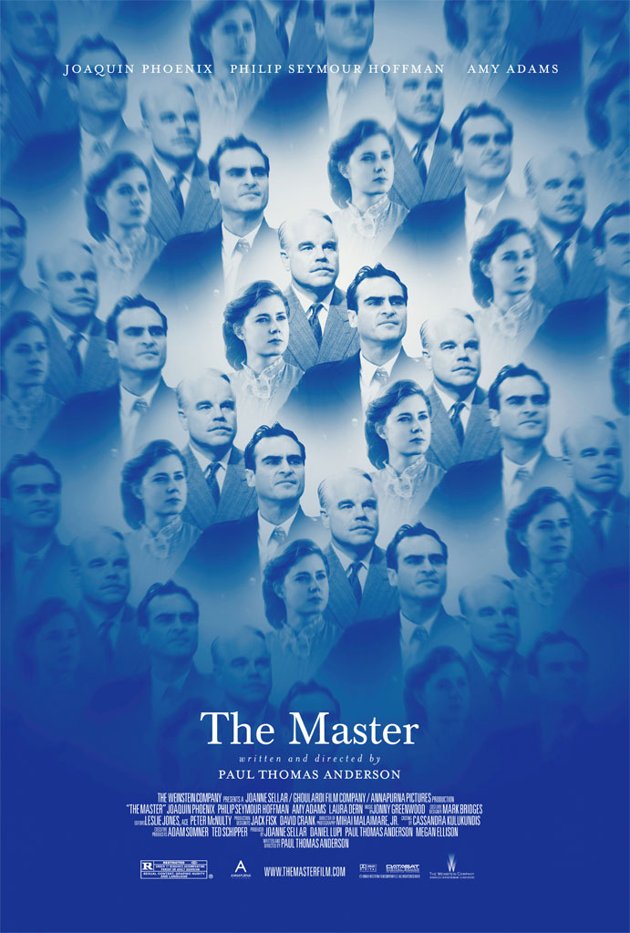
The Master, or How PTA's Rorschach is spell-binding


The Master
Written & Directed by: P. T. Anderson
Starring: Joaquin Phoenix, Philip Seymour Hoffman, Amy Adams & Laura Dern.

Oscar Nominations: 3
Best Supporting Actor (Philip Seymour Hoffman), Best Supporting Actress (Amy Adams) & Best Actor (Joaquin Phoenix)

Few films baffled and challenged me more than Paul Thomas Anderson's cryptic The Master. Shot beautifully in 70mm, the film's opaqueness almost presents itself as a Rorschach test to its audience, not unlike the one featured early on as we meet Freddy (Phoenix). While the film clearly tackles issues of cult-like faith in the figure of L. Ron Hubbard-lookalike Lancaster Dodd (Hoffman), the film to me felt to me as the most searing look at post-war American masculinity I had seen on screen in a long time. As Naval-veteran Freddy, Joaquin Phoenix creates an amalgam of the post-war American male. Contorted in posture, crippled by unbridled lust and dangerously aimless, Freddy moves from job to job after coming back from fighting only to find himself stranded aboard the Dodd's boat. What follows is the improbable (albeit platonic) romance between Freddy and Dodd as the latter takes the former in as his disciple, intent on curbing Freddy's animal impulses and prove the efficacy of his own teachings. Following There Will be Blood, this is an important chapter in Anderson's continued interest in deconstructing the myths that make up the United States.

Anderson's meditative film is best experienced rather than described. Its dianetics-influenced structure of probing questions and unintelligible answers proves frustrating at times, but it is worth a dizzying gander. A-

Wednesday, January 30, 2013

Flight, or How not even Denzel could land this thing


Flight
Directed by: Robert Zemeckis
Written by: John Gatins
Starring: Denzel Washington, Kelly Reilly, John Goodman, Don Cheadle & Melissa Leo.

Oscar Nominations: 2
Best Original Screenplay (John Gatins) & Best Actor (Denzel Washington)

Flight opens with a plane crash-landing sequence that is riveting, expertly crafted and ultimately the film's undoing: nothing ever quite lives up to it. Following pilot Whip Whitaker (Washington) as he drunkenly -- if masterfully -- lands a troubled plane, going so far as to steer it upside down, Zemeckis and Gatins set the scene for a story of an addict faced with improbable survival. A savior in the eyes of the media, his addiction quickly establishes him as the potential scapegoat for the airline which faces a branding catastrophe should it accept full blame on the plane's crash. Yet this legal battle feels like window-dressing once it's clear the film is more interested in the personal demons that haunt Washington's Whip.

We have seen this alcoholic-trying-to-sober up story time and time again yet other than a charmingly biting scene at the hospital staircase (courtesy of James Badgley Dale's cancer-stricken character), the film never quite achieves the high-wire act of bringing together faith, addiction and duty, coming off instead as a glossier Lifetime movie of the week. The insurance problems, the high-stakes hearings (which feature the other standout of the film, Melissa Leo) and the airline backdrop attempt to raise the stakes but ultimately the step-and-repeat structure cripples any suspense. When we see a close-up of a mini-bar bottle of vodka, any tension is dissipated by the fact that the scene plays out just as one would expect. At that point, Gatins and Zemeckis hope I'm rooting for Whip yet looking at what's on the screen, we are not given much to root for. Instead, much of the film heavily relies on Washington's own charisma to elicit our own empathy. Several shots of him walking indoors with his shades indoors wish to marry the cool-cat attitude of Washington-the-star with the miserable and hungover feeling of Washington-as-Whip. Sadly, not even Washington's star persona (which, disclaimer, has never smitten me) can keep this film from crashing into its own cliches. C

Monday, January 28, 2013

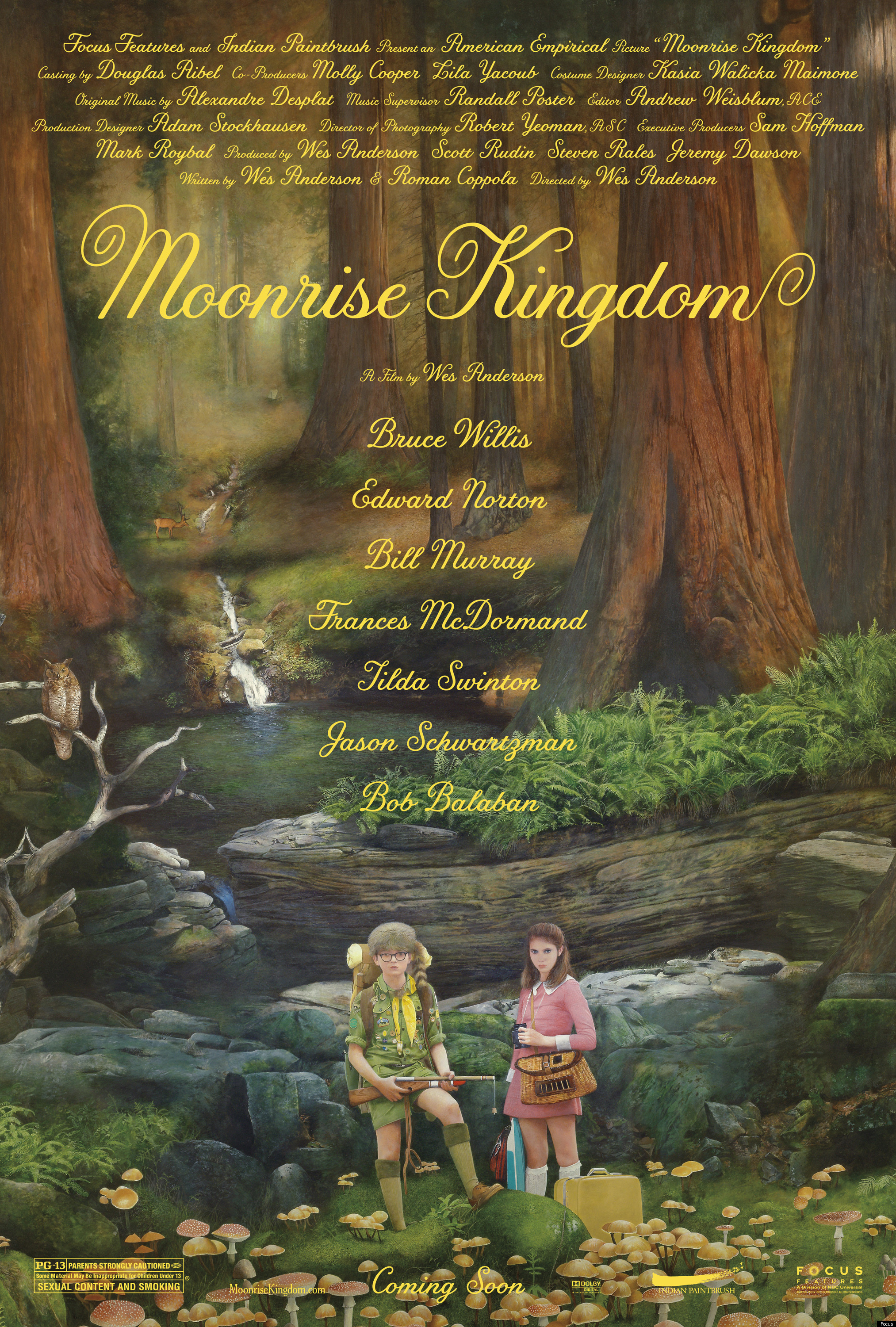
Moonrise Kingdom, or How Anderson's twee-love story is gorgeous and affecting


Moonrise Kingdom
Directed by Wes Anderson
Written by Wes Anderson & Roman Coppola
Starring Jared Gilman, Kara Hayward, Bruce Willis, Frances McDormand, Tilda Swinton, Bill Murray, Edward Norton & Bob Balaban.

Oscar Nominations: 1
Best Original Screenplay

The scene: A beach on the New England coast. A portable record player blares a fittingly titled song "Les Temps de l'Amour." A boy and a girl, both in their underwear, begin awkwardly yet endearingly dancing to this playful tune. Deciding to slow dance, they turn to each other and kiss primly on the lips. This escalates to fumbling french kisses, over-the-bra touching and ends with the two laying side by side on a makeshift Khaki Scout tent.

This scene epitomizes the mix of child-like wonder and burgeoning teen desire that permeates the film. Aesthetically, Anderson uses his knack for making the world into a primrose-colored tableau-vivant to envelop the romance between introvert Sam (Gilman) and Suzy (Hayward) with a hint of fantasy. Sam and Suzy's romantic escapade throws into relief the very infantile adult world around them which includes an unhappy marriage, an illicit affair and a bumbling scout leader. That Sam and Suzy are never reduced to the grating precociousness of cinema kids is both a testament to Anderson's smart script and his nuanced child actors. Despite its jejune art direction -- which aims for a storybook feel -- Anderson's film never stoops to the condescension that is usually directed at these coming-of-age protagonists. That it is the adults who find themselves entangled in juvenile antics yet committed to the responsibilities of their age deepen Anderson's wistful look at Sam and Suzy's epistolary (and later runaway) love story. Filled throughout with Anderson's signature droll humour and visual flair, Moonrise Kingdom is a lovely film about the joys of love and the heartbreak of growing up. A

Saturday, January 26, 2013

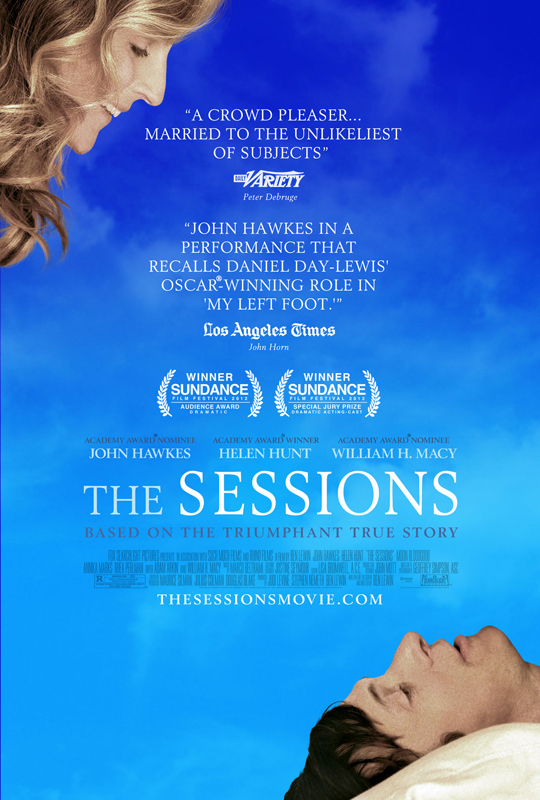
The Sessions or How Hawkes and Hunt shine


The Sessions
Written & Directed: Ben Lewin
Starring: John Hawkes, Helen Hunt, Moon Bloodgood & William H. Macy.

Oscar Nominations: 1
Best Supporting Actress (Helen Hunt)

Of all the one-nomination wonders this year, The Sessions might be my favorite (Mirror Mirror is a close second). Lewin's warmly funny film follows Mark a writer in an iron lung (Hawkes) who wishes to lose his virginity at the ripe age of 38. For this he hires sex-surrogate Cheryl (Hunt) who agrees to coach him for six sessions to achieve this feat despite Mark's physical impediments. While the subject matter (disabled man pays woman for sex) may sound unseemly, Lewin and his cast have crafted a smart comedy about sex and intimacy that while bordering on a romantic comedy, never loses sight of its unabashed sexual politics (the implicit love and affection that blossoms between Mark and Cheryl, and which begins to creep into Cheryl's own marriage is mostly glossed over despite its potential to sanitize the central plot of Mark's sexual fulfillment). The movie -- while less of a PSA for disability sex than it sounds -- breaks less ground than it would like to, but still manages to create in Mark a funny and smart writer whose disability is not solely what defines him nor what limits him. Not to be trite, but it is very refreshing to find a movie try to navigate these issues without being condescending to its subject, though most of that is thanks to Hawkes's nasal-voiced Mark who yearns for the touch of a woman.

The movie moves breezily through Cheryl and Mark's sessions from awkward first encounter ("Mark, I'm not a hooker") to the -- yes, predictable but not for that less exciting -- climax of Mark's first sexual encounter with penetration. For a movie that goes out of its way to put its actors in uncomfortable situations (Hunt is naked for most of her scenes; Hawkes is restricted to a bed for all of it), Hunt and Hawkes have created a wonderful pair and bring out honest performances as they tackle the high-wire act of making a movie about sex come off as a pleasant little comedy without losing the pathos inherent in that sexual journey. B+

Thursday, January 24, 2013

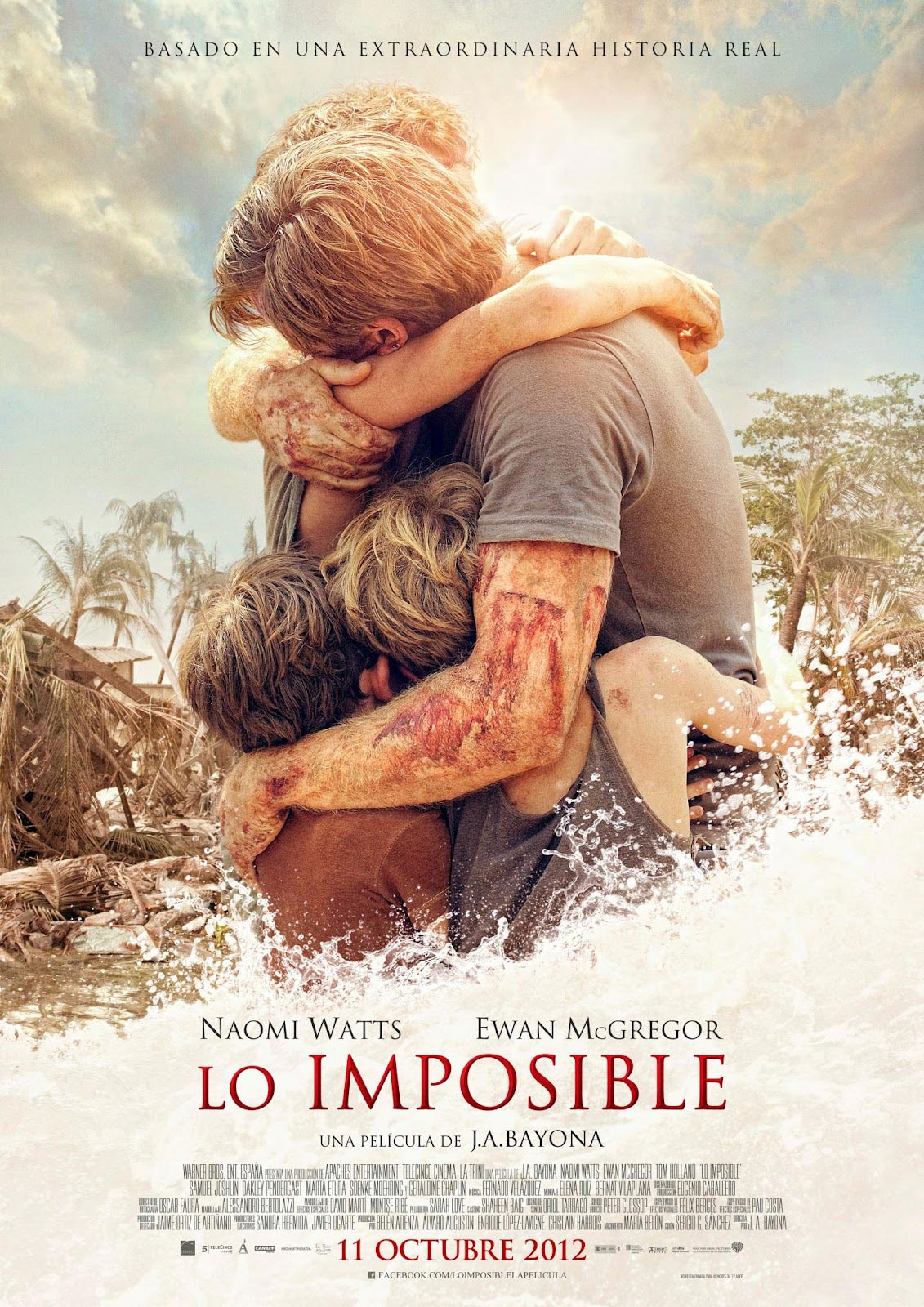
The Impossible, or How Watts floats above tsunami flick


I'm starting off the Oscar Challenge 2013 with the film that nabbed Naomi Watts her second Oscar nomination.


The Impossible
Director: Juan Antonio Bayona
Writer: Sergio G. Sánchez
Starring: Naomi Watts, Ewan McGregor, Tom Holland.

Oscar Nomination:  1
Best Actress (Naomi Watts)

That the person who directed the excellent mommy thriller El Orfanato (2007) has directed this real-life disaster flick set in Thailand during the horrific 2004 tsumani becomes a bit more obvious once you realize Bayona and Sánchez dwell in the scary aftermath of the attack through the figure of Watts' Maria. But while El Orfanato aimed for soft-whispers and creaky hinges to build up the blood-curdling set up of an orphaned ghost child, Lo Imposible goes instead for maudlin sentimentality as it traces Maria's grueling journey back to her husband (McGregor) and their two other children. That the film survives the paint-by-numbers (if true) plot of this white family's reunion is mostly due to its three leads. Bayona rightly taps into Watts' intensity and McGregor's vulnerability to ground the spectacle around them (that the visual effects and make-up teams didn't even make their respective Oscar bake-offs is a bit baffling) but it is in Holland where the film finds its most valuable asset. He more than ably carries the film, vacillating between loud desperation and quiet distress, offering the film an anchor even when engaged in wholly contrived (even if true) near-miss encounters with his fatherr that could be just at home in a comedy sketch routine. C+

Tuesday, January 22, 2013

The Oscar Challenge, or How it's time to work on my reviewing skills


So Oscar nominations came and went and now we have a longer than usual six-weeks to go until the big night. How to entertain ourselves until then? Well, we could try and play pundit and try to imagine the various ways new rules in Live Action Short, Animated Short and Documentary could play out; toy with various Oscar stats and figure out whether Riva can beat Jennifer and Jessica, whether Argo has what it takes to make Oscar history... but that's best left to pros like Nat, Joe or Guy. Instead, I want to flex my film reviewer muscles (which have atrophied a bit) and thus I created for myself the Oscar Challenge of 2013. I have seen most of the nominated films -- a feat I rarely achieve by nomination mornings -- and so from here until the big night, I will be reviewing the 14 films nominated for the Big Eight above-the-line categories, in order from least number of total nominations to most. And yes, you should be surprised that only 14 films hogged over 44 slots with both Supporting Acting slots and the Adapted race being taken up by Best Pic nominees. To think Perks of Being a Wallflower, Kidman, McConaughey, Dowd, Bardem, or Looper could have easily helped spread the wealth around. 

In any case, here are the films: 

1 nom
Best Actress

1 nom
Best Supporting Actress

Moonrise Kingdom (A)
1 nom
Best Original Screenplay 

2 noms
Best Actor, Best Original Screenplay

3 noms
Best Supporting Actress, Best Supporting Actor, Best Actor

4 noms
Best Adapted Screenplay, Best Actress, Best Director, Best Picture

5 noms
Best Original Screenplay, Best Cinematography, Best Sound Editing, Best Supporting Actor, Best Picture

5 noms
Best Original Screenplay, Best Editing, Best Sound Editing, Best Actress, Best Picture

5 noms
Best Actress, Best Foreign Language Film, Best Original Screenplay, Best Director Best Picture

7 noms
Best Editing, Best Adapted Screenplay, Best Original Score, Best Sound Mixing, Best Sound Editing, Best Supporting Actor, Best Picture

8 noms
Best Editing, Best Adapted Screenplay, Best Supporting Actress, Best Supporting Actor, Best Actress, Best Actor, Best Director, Best Picture

8 noms
Best Original Song, Best Sound Mixing, Best Costume Design, Best Production Design, Best Make-Up and Hairstyling, Best Supporting Actress, Best Actor, Best Picture

11 noms
Best Original Song, Best Score, Best Sound Mixing, Best Sound Editing, Best Production Design, Best Visual Effects, Best Adapted Screenplay, Best Editing, Best Director, Best Picture

12 noms
Best Score, Best Cinematography, Best Sound Mixing, Best Production Design, Best Costume Design, Best Editing, Best Adapted Screenplay, Best Supporting Actor, Best Supporting Actress, Best Actor, Best Director, Best Picture

Wednesday, January 9, 2013

Oscar Predictions, or How why not, right? [UPDATED]

Trust the Academy Award nominations to get me to blog more; and why not? I'm very excited about tomorrow's announcement -- not least because I'll finally be able to start planning my annual cupcake Oscar bash. I have plenty of ideas of how to decorate a Life of Pi cupcake (blue frosting, orange life-saver), but if my predictions are anything to go by (they're not) I'll have to get creative. How does one distil the cruel humane streak of Amour or the obsessive documentary nature of Zero Dark Thirty into a cupcake delicacy?

[UPDATED WITH ACTUAL NOMINATIONS]
So Bigelow and Affleck both missed out on Best Director citations (despite Zero Dark Thirty and Argo having a good showing in some key tech categories, though ZD30 missing out on Cinematography is telling, I guess). Lincoln led the pack, as we presumed and Kidman, Perks, Hawkes, Cotillard and others were left out in the cold. You win some and you lose some in this game, no? Still, it would have been great for Bigelow to break the record by being the sole female director to get a second nominations but alas.

It definitely shakes things up as we head into the next phase of voting: is it going to be a Lincoln-fest, or is the strength of Playbook (scoring in all four categories -- the first since Reds (1981)) and Life of Pi (both films also scoring in the telling Editing category) enough to warrant a horse-race? Or can Zero or Argo overcome the no-director bid to score the big win and be the first film to do so since Driving Miss Daisy? Interesting things to ponder, though I do worry that we went from a totally unpredictable race to one that seems to have left Lincoln in a position to take it all. We'll see.

As for my predictions, I scored a 64/87 which I guess isn't bad (74%) though the fact that I stayed away from harder categories (Song, Shorts, etc.) probably helped. 

As they stand, my predictions suggest that the presumptive leader will be Lincoln (with what I'm thinking is a plausible 12 nominations) with Life of Pi (7), Argo (7) and Les Miserables (6) right behind it (though these don't factor in Song -- as who the hell knows with that category -- which could give the Ang Lee fable and the in-your-face musical an extra nomination each). The numbers don't quite feel right but I shuffled things around and that's where they left me. Acting-wise, I'm hoping Kidman's GG-SAG translates into a nomination while I'm banking on DiCaprio to break the "former winner" Supporting Actor club (which might still happen should Bardem or Waltz get in over Leo). I'm hoping Les Miserables misses Best Director while giving the edge to Haneke (it's also plausible we'd get our first lone director nom though what's more likely is that the French gem gets shut out of both but I'm hopeful!). As for the out-of-the-blue nominations that always surprise us... I couldn't find one unless you count my WGA-approved Looper/Perks of Being a Wallflower duo. Will there be an Extremely Loud & Incredibly Close nomination (maybe Best Exotic Marigold Hotel)? Will Skyfall crack the top categories? Will Django be more of an Inglorious Basterds or a Kill Bill situation? Tune in tomorrow to find out!


BEST PICTURE [8/9]
Amour
Argo
Django Unchained
Lincoln
Life of Pi
Les Miserables
Moonrise Kingdom

Silver Linings Playbook
Zero Dark Thirty

Beasts of the Southern Wild
alt. The Master

BEST DIRECTOR [3/5]
Ben Affleck, Argo
Kathryn Bigelow, Zero Dark Thirty
Michael Haneke, Amour
Ang Lee, Life of Pi
Steven Spielberg, Lincoln
David O. Russell, Silver Linings Playbook
Benh Zeitlin, Beasts of the Southern Wild
alt. Quentin Tarantino, Django Unchained

BEST ACTOR [4/5]
Daniel Day Lewis, Lincoln
John Hawkes, The Sessions
Hugh Jackman, Les Miserables
Joaquin Phoenix, The Master
Denzel Washington, Flight
alt. Bradley Cooper, Silver Linings Playbook

BEST ACTRESS [4/5]
Jessica Chastain, Zero Dark Thirty
Marion Cotillard, Rust & Bone
Jennifer Lawrence, Silver Linings Playbook
Emanuelle Riva, Amour
Naomi Watts, The Impossible
Quvenzhané Wallis, Beasts of the Southern Wild
alt. Helen Mirren, Hitchcock

BEST SUPPORTING ACTOR [4/5]
Alan Arkin, Argo
Robert DeNiro, Silver Linings Playbook
Leonardo DiCaprio, Django Unchained
Philip Seymour Hoffman, The Master
Tommy Lee Jones, Lincoln
Christoph Waltz, Django Unchained
alt. Javier Bardem, Skyfall

BEST SUPPORTING ACTRESS [3/5]
Sally Field, Lincoln
Anne Hathaway, Les Miserables
Helen Hunt, The Sessions
Nicole Kidman, The Paperboy
Maggie Smith, The Best Exotic Marigold
Jacki Weaver, Silver Linings Playbook
alt. Amy Adams, The Master

BEST ORIGINAL SCREENPLAY [4/5]
Django Unchained
The Master
Moonrise Kingdom
Looper
Zero Dark Thirty
Flight
alt. Amour

BEST ADAPTED SCREENPLAY [4/5]
Argo
Beasts of the Southern Wild
Lincoln
Perks of Being a Wallflower
Silver Linings Playbook
alt. Life of Pi

BEST EDITING [4/5]
Argo
Django Unchained

Life of Pi
Lincoln
Zero Dark Thirty

Silver Linings Playbook
alt. Skyfall

BEST CINEMATOGRAPHY [4/5]

Anna Karenina
Lincoln
Life of Pi
Skyfall
Zero Dark Thirty

Django Unchained
alt. Argo

BEST SCORE [4/5]
Anna Karenina
Argo
Life of Pi
Lincoln
Zero Dark Thirty

Skyfall
alt. Cloud Atlas

BEST PRODUCTION DESIGN [2/5]
Anna Karenina
Argo

Lincoln
Life of Pi
The Hobbit
Les Miserables
The Master
Prometheus

alt. Django Unchained

BEST COSTUME DESIGN [5/5]
Anna Karenina
Les Miserables
Lincoln
Mirror Mirror
Snow White and the Huntsman
alt. Django Unchained

BEST MAKEUP AND HAIR STYLING [1/3]
The Hobbit: An Unexpected Journey
Lincoln
Men in Black III
Les Miserables
alt. Hitchcock

BEST VISUAL EFFECTS [4/5]
The Avengers
The Dark Knight Rises
The Hobbit: An Unexpected Journey
Life of Pi
Prometheus
alt. Snow White and the Huntsman

BEST SOUND EDITING [3/5]
Django Unchained
The Dark Knight Rises
Les Miserables
Skyfall
Zero Dark Thirty
Argo
alt. Life of Pi

BEST SOUND MIXING [3/5]
The Avengers
Life of Pi
Les Miserables
Skyfall
Zero Dark Thirty

Argo
Lincoln
alt. The Hobbit: An Unexpected Journey