Saturday, January 26, 2013

The Sessions or How Hawkes and Hunt shine


The Sessions
Written & Directed: Ben Lewin
Starring: John Hawkes, Helen Hunt, Moon Bloodgood & William H. Macy.

Oscar Nominations: 1
Best Supporting Actress (Helen Hunt)

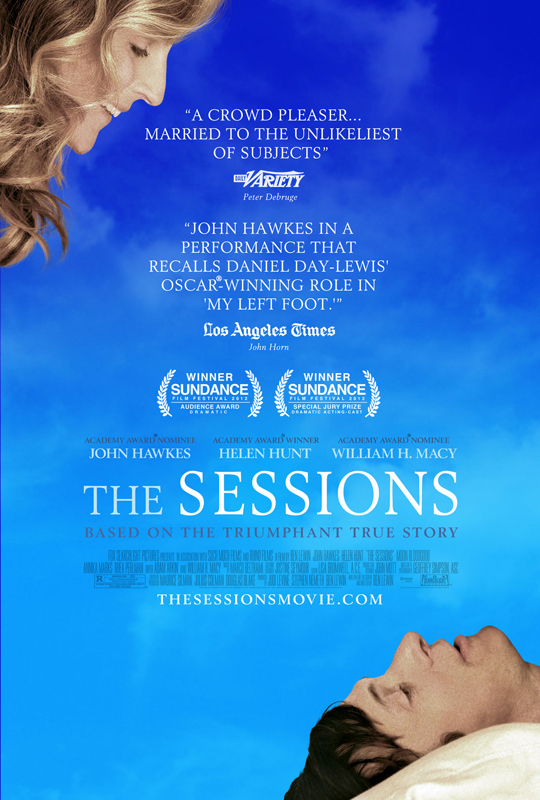
Of all the one-nomination wonders this year, The Sessions might be my favorite (Mirror Mirror is a close second). Lewin's warmly funny film follows Mark a writer in an iron lung (Hawkes) who wishes to lose his virginity at the ripe age of 38. For this he hires sex-surrogate Cheryl (Hunt) who agrees to coach him for six sessions to achieve this feat despite Mark's physical impediments. While the subject matter (disabled man pays woman for sex) may sound unseemly, Lewin and his cast have crafted a smart comedy about sex and intimacy that while bordering on a romantic comedy, never loses sight of its unabashed sexual politics (the implicit love and affection that blossoms between Mark and Cheryl, and which begins to creep into Cheryl's own marriage is mostly glossed over despite its potential to sanitize the central plot of Mark's sexual fulfillment). The movie -- while less of a PSA for disability sex than it sounds -- breaks less ground than it would like to, but still manages to create in Mark a funny and smart writer whose disability is not solely what defines him nor what limits him. Not to be trite, but it is very refreshing to find a movie try to navigate these issues without being condescending to its subject, though most of that is thanks to Hawkes's nasal-voiced Mark who yearns for the touch of a woman.

The movie moves breezily through Cheryl and Mark's sessions from awkward first encounter ("Mark, I'm not a hooker") to the -- yes, predictable but not for that less exciting -- climax of Mark's first sexual encounter with penetration. For a movie that goes out of its way to put its actors in uncomfortable situations (Hunt is naked for most of her scenes; Hawkes is restricted to a bed for all of it), Hunt and Hawkes have created a wonderful pair and bring out honest performances as they tackle the high-wire act of making a movie about sex come off as a pleasant little comedy without losing the pathos inherent in that sexual journey. B+

Thursday, January 24, 2013

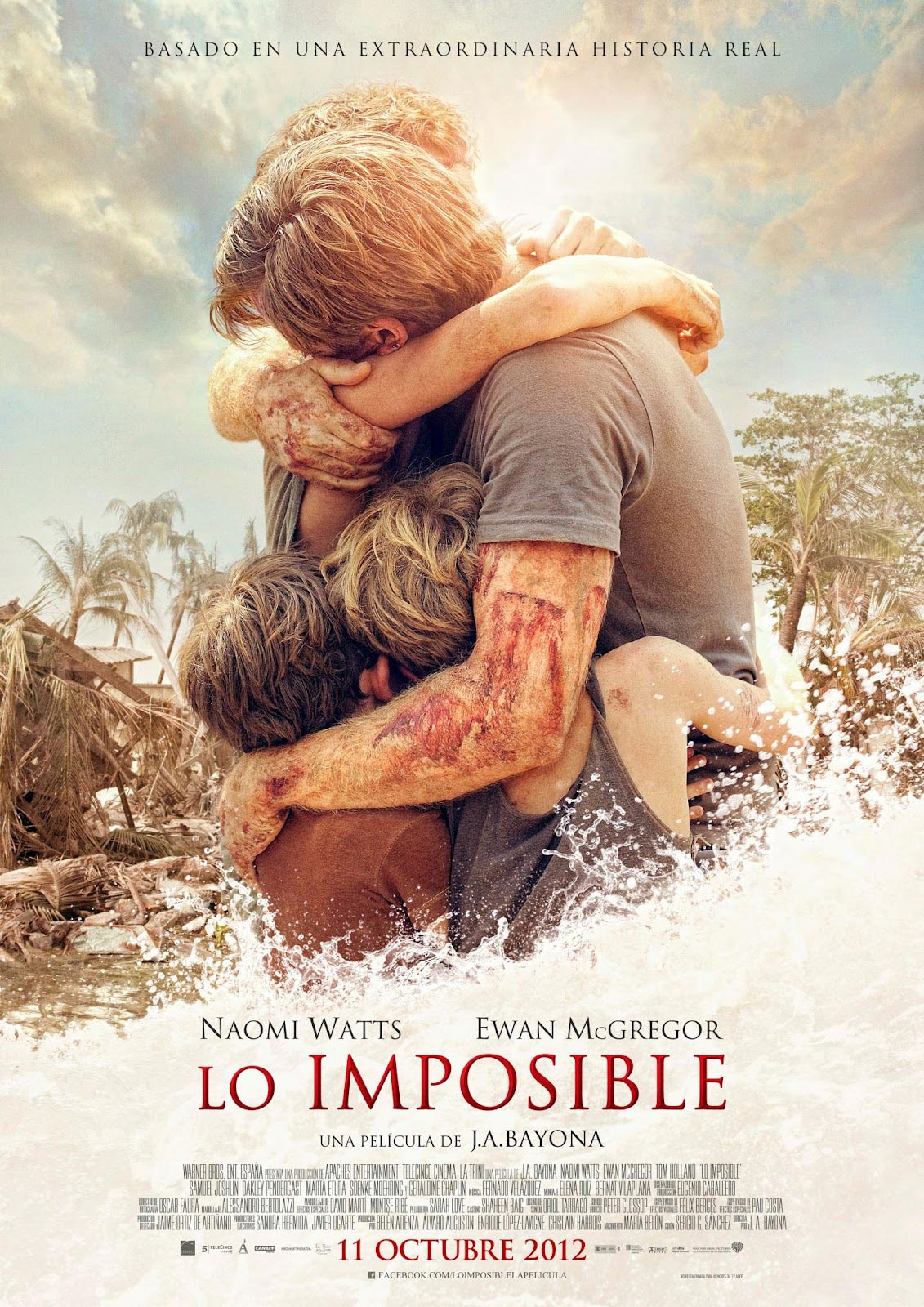
The Impossible, or How Watts floats above tsunami flick


I'm starting off the Oscar Challenge 2013 with the film that nabbed Naomi Watts her second Oscar nomination.


The Impossible
Director: Juan Antonio Bayona
Writer: Sergio G. Sánchez
Starring: Naomi Watts, Ewan McGregor, Tom Holland.

Oscar Nomination:  1
Best Actress (Naomi Watts)

That the person who directed the excellent mommy thriller El Orfanato (2007) has directed this real-life disaster flick set in Thailand during the horrific 2004 tsumani becomes a bit more obvious once you realize Bayona and Sánchez dwell in the scary aftermath of the attack through the figure of Watts' Maria. But while El Orfanato aimed for soft-whispers and creaky hinges to build up the blood-curdling set up of an orphaned ghost child, Lo Imposible goes instead for maudlin sentimentality as it traces Maria's grueling journey back to her husband (McGregor) and their two other children. That the film survives the paint-by-numbers (if true) plot of this white family's reunion is mostly due to its three leads. Bayona rightly taps into Watts' intensity and McGregor's vulnerability to ground the spectacle around them (that the visual effects and make-up teams didn't even make their respective Oscar bake-offs is a bit baffling) but it is in Holland where the film finds its most valuable asset. He more than ably carries the film, vacillating between loud desperation and quiet distress, offering the film an anchor even when engaged in wholly contrived (even if true) near-miss encounters with his fatherr that could be just at home in a comedy sketch routine. C+

Tuesday, January 22, 2013

The Oscar Challenge, or How it's time to work on my reviewing skills


So Oscar nominations came and went and now we have a longer than usual six-weeks to go until the big night. How to entertain ourselves until then? Well, we could try and play pundit and try to imagine the various ways new rules in Live Action Short, Animated Short and Documentary could play out; toy with various Oscar stats and figure out whether Riva can beat Jennifer and Jessica, whether Argo has what it takes to make Oscar history... but that's best left to pros like Nat, Joe or Guy. Instead, I want to flex my film reviewer muscles (which have atrophied a bit) and thus I created for myself the Oscar Challenge of 2013. I have seen most of the nominated films -- a feat I rarely achieve by nomination mornings -- and so from here until the big night, I will be reviewing the 14 films nominated for the Big Eight above-the-line categories, in order from least number of total nominations to most. And yes, you should be surprised that only 14 films hogged over 44 slots with both Supporting Acting slots and the Adapted race being taken up by Best Pic nominees. To think Perks of Being a Wallflower, Kidman, McConaughey, Dowd, Bardem, or Looper could have easily helped spread the wealth around. 

In any case, here are the films: 

1 nom
Best Actress

1 nom
Best Supporting Actress

Moonrise Kingdom (A)
1 nom
Best Original Screenplay 

2 noms
Best Actor, Best Original Screenplay

3 noms
Best Supporting Actress, Best Supporting Actor, Best Actor

4 noms
Best Adapted Screenplay, Best Actress, Best Director, Best Picture

5 noms
Best Original Screenplay, Best Cinematography, Best Sound Editing, Best Supporting Actor, Best Picture

5 noms
Best Original Screenplay, Best Editing, Best Sound Editing, Best Actress, Best Picture

5 noms
Best Actress, Best Foreign Language Film, Best Original Screenplay, Best Director Best Picture

7 noms
Best Editing, Best Adapted Screenplay, Best Original Score, Best Sound Mixing, Best Sound Editing, Best Supporting Actor, Best Picture

8 noms
Best Editing, Best Adapted Screenplay, Best Supporting Actress, Best Supporting Actor, Best Actress, Best Actor, Best Director, Best Picture

8 noms
Best Original Song, Best Sound Mixing, Best Costume Design, Best Production Design, Best Make-Up and Hairstyling, Best Supporting Actress, Best Actor, Best Picture

11 noms
Best Original Song, Best Score, Best Sound Mixing, Best Sound Editing, Best Production Design, Best Visual Effects, Best Adapted Screenplay, Best Editing, Best Director, Best Picture

12 noms
Best Score, Best Cinematography, Best Sound Mixing, Best Production Design, Best Costume Design, Best Editing, Best Adapted Screenplay, Best Supporting Actor, Best Supporting Actress, Best Actor, Best Director, Best Picture

Friday, January 18, 2013

Writing Soundtracks, or How Film Scores Inspire Me

As a graduate student, I spend a good part of my time writing. This can get quite boring, if not outright unbearable without some good music to go with it. When I am editing I can get away with singing along to the new Adele or Frank Ocean (okay, sometimes I also bounce to Britney and Kylie). When it comes to facing the blank screen and trying to come up with dissertation-level arguments, I have to admit that I tend to stay away from songs I can sing if not outright dance along. Instead, I turn to -- what else? -- film scores. 

I bring this up because last tonight, @SeriousFilm caught my eye with the following tweet:


And, not to sound too much like Carrie Bradshaw, but this got me thinking about the type of film scores that I'm drawn to and listen to the most when I'm writing. Needless to say, a great soundtrack (take for example, Clint Mansell's Black Swan or Michael Giacchino's The Incredibles) doesn't usually make for a good writing soundtrack (unless I wanted to feel like I'm constantly paranoid and/or running away from a giant robot trying to kill me). That said, my four favorite scores to write to manage to be both fantastic scores on their own accord -- elevating and nuancing the films they belong to -- even as they make for pleasantly unobtrusive writing soundtracks. Funnily enough they all belong to films that ended up in my Top 2/3 for each of their respective years Glass's minimalist score for The Hours, Marianelli's typewriter-infused tunes for Atonement, Newman's fittingly dour ditties for Revolutionary Road and Iglesias's moody themes for Tinker Tailor Soldier Spy are in constant rotation on my iTunes and Spotify (though sometimes I'm in the mood for the pulsating beats of The Social Network, for the Pan's Labyrinth lullabies and even for a Desplat or two). I don't think it's a surprise that the first two speak directly to the process of writing (Woolf with an inked-pen in hand; Robbie's infamous typewritten note) as I'm sure my mind wanders back to those scenes as I stare into the blank screen in front of me. I mean, what better way to stimulate writing than to plunge into the psyche of Smiley and his single-minded approach to his work? Or into the lovingly broken hearts of April and Frank Wheeler? Okay, maybe only the former as the latter makes me sound like a masochist. My point is that this is what great scores accomplish; they at once help construct and complement the moods and emotions we see on screen. A bad score is always distracting (be it in its contrivance or in its obvious emotional machinations), but a good score is both felt yet unseen, which is exactly what I need for when I write.


As my choices show, I'm more drawn to the quiet and restrained scores which makes sense as I don't think I know anyone who'd want Williams bombast or Zimmer horns blaring as you try to explain how fan-like adoration of cinema infected the aesthetics of twentieth century queer writers.

Of the scores this year, I have found the Russian flavored score for Anna Karenina (my pick of the Oscar five) and the intertwining tunes of Cloud Atlas have made for good writing soundtracks, but I'm curious to know if anyone has any suggestions (old or new!) as I'm always eager to discover new music that can keep me inspired and stimulated as I work my way through this dissertation.

Wednesday, January 9, 2013

Oscar Predictions, or How why not, right? [UPDATED]

Trust the Academy Award nominations to get me to blog more; and why not? I'm very excited about tomorrow's announcement -- not least because I'll finally be able to start planning my annual cupcake Oscar bash. I have plenty of ideas of how to decorate a Life of Pi cupcake (blue frosting, orange life-saver), but if my predictions are anything to go by (they're not) I'll have to get creative. How does one distil the cruel humane streak of Amour or the obsessive documentary nature of Zero Dark Thirty into a cupcake delicacy?

[UPDATED WITH ACTUAL NOMINATIONS]
So Bigelow and Affleck both missed out on Best Director citations (despite Zero Dark Thirty and Argo having a good showing in some key tech categories, though ZD30 missing out on Cinematography is telling, I guess). Lincoln led the pack, as we presumed and Kidman, Perks, Hawkes, Cotillard and others were left out in the cold. You win some and you lose some in this game, no? Still, it would have been great for Bigelow to break the record by being the sole female director to get a second nominations but alas.

It definitely shakes things up as we head into the next phase of voting: is it going to be a Lincoln-fest, or is the strength of Playbook (scoring in all four categories -- the first since Reds (1981)) and Life of Pi (both films also scoring in the telling Editing category) enough to warrant a horse-race? Or can Zero or Argo overcome the no-director bid to score the big win and be the first film to do so since Driving Miss Daisy? Interesting things to ponder, though I do worry that we went from a totally unpredictable race to one that seems to have left Lincoln in a position to take it all. We'll see.

As for my predictions, I scored a 64/87 which I guess isn't bad (74%) though the fact that I stayed away from harder categories (Song, Shorts, etc.) probably helped. 

As they stand, my predictions suggest that the presumptive leader will be Lincoln (with what I'm thinking is a plausible 12 nominations) with Life of Pi (7), Argo (7) and Les Miserables (6) right behind it (though these don't factor in Song -- as who the hell knows with that category -- which could give the Ang Lee fable and the in-your-face musical an extra nomination each). The numbers don't quite feel right but I shuffled things around and that's where they left me. Acting-wise, I'm hoping Kidman's GG-SAG translates into a nomination while I'm banking on DiCaprio to break the "former winner" Supporting Actor club (which might still happen should Bardem or Waltz get in over Leo). I'm hoping Les Miserables misses Best Director while giving the edge to Haneke (it's also plausible we'd get our first lone director nom though what's more likely is that the French gem gets shut out of both but I'm hopeful!). As for the out-of-the-blue nominations that always surprise us... I couldn't find one unless you count my WGA-approved Looper/Perks of Being a Wallflower duo. Will there be an Extremely Loud & Incredibly Close nomination (maybe Best Exotic Marigold Hotel)? Will Skyfall crack the top categories? Will Django be more of an Inglorious Basterds or a Kill Bill situation? Tune in tomorrow to find out!


BEST PICTURE [8/9]
Amour
Argo
Django Unchained
Lincoln
Life of Pi
Les Miserables
Moonrise Kingdom

Silver Linings Playbook
Zero Dark Thirty

Beasts of the Southern Wild
alt. The Master

BEST DIRECTOR [3/5]
Ben Affleck, Argo
Kathryn Bigelow, Zero Dark Thirty
Michael Haneke, Amour
Ang Lee, Life of Pi
Steven Spielberg, Lincoln
David O. Russell, Silver Linings Playbook
Benh Zeitlin, Beasts of the Southern Wild
alt. Quentin Tarantino, Django Unchained

BEST ACTOR [4/5]
Daniel Day Lewis, Lincoln
John Hawkes, The Sessions
Hugh Jackman, Les Miserables
Joaquin Phoenix, The Master
Denzel Washington, Flight
alt. Bradley Cooper, Silver Linings Playbook

BEST ACTRESS [4/5]
Jessica Chastain, Zero Dark Thirty
Marion Cotillard, Rust & Bone
Jennifer Lawrence, Silver Linings Playbook
Emanuelle Riva, Amour
Naomi Watts, The Impossible
Quvenzhané Wallis, Beasts of the Southern Wild
alt. Helen Mirren, Hitchcock

BEST SUPPORTING ACTOR [4/5]
Alan Arkin, Argo
Robert DeNiro, Silver Linings Playbook
Leonardo DiCaprio, Django Unchained
Philip Seymour Hoffman, The Master
Tommy Lee Jones, Lincoln
Christoph Waltz, Django Unchained
alt. Javier Bardem, Skyfall

BEST SUPPORTING ACTRESS [3/5]
Sally Field, Lincoln
Anne Hathaway, Les Miserables
Helen Hunt, The Sessions
Nicole Kidman, The Paperboy
Maggie Smith, The Best Exotic Marigold
Jacki Weaver, Silver Linings Playbook
alt. Amy Adams, The Master

BEST ORIGINAL SCREENPLAY [4/5]
Django Unchained
The Master
Moonrise Kingdom
Looper
Zero Dark Thirty
Flight
alt. Amour

BEST ADAPTED SCREENPLAY [4/5]
Argo
Beasts of the Southern Wild
Lincoln
Perks of Being a Wallflower
Silver Linings Playbook
alt. Life of Pi

BEST EDITING [4/5]
Argo
Django Unchained

Life of Pi
Lincoln
Zero Dark Thirty

Silver Linings Playbook
alt. Skyfall

BEST CINEMATOGRAPHY [4/5]

Anna Karenina
Lincoln
Life of Pi
Skyfall
Zero Dark Thirty

Django Unchained
alt. Argo

BEST SCORE [4/5]
Anna Karenina
Argo
Life of Pi
Lincoln
Zero Dark Thirty

Skyfall
alt. Cloud Atlas

BEST PRODUCTION DESIGN [2/5]
Anna Karenina
Argo

Lincoln
Life of Pi
The Hobbit
Les Miserables
The Master
Prometheus

alt. Django Unchained

BEST COSTUME DESIGN [5/5]
Anna Karenina
Les Miserables
Lincoln
Mirror Mirror
Snow White and the Huntsman
alt. Django Unchained

BEST MAKEUP AND HAIR STYLING [1/3]
The Hobbit: An Unexpected Journey
Lincoln
Men in Black III
Les Miserables
alt. Hitchcock

BEST VISUAL EFFECTS [4/5]
The Avengers
The Dark Knight Rises
The Hobbit: An Unexpected Journey
Life of Pi
Prometheus
alt. Snow White and the Huntsman

BEST SOUND EDITING [3/5]
Django Unchained
The Dark Knight Rises
Les Miserables
Skyfall
Zero Dark Thirty
Argo
alt. Life of Pi

BEST SOUND MIXING [3/5]
The Avengers
Life of Pi
Les Miserables
Skyfall
Zero Dark Thirty

Argo
Lincoln
alt. The Hobbit: An Unexpected Journey

Tuesday, January 8, 2013

All the world's a stage for suffering women, or How I'm seeing double

A couple of weeks ago I treated myself to what has to be the weirdest double feature I could have concocted: Lars von Trier's Dogville and Joe Wright's Anna Karenina. Wright's social-politics-as-balletic-performances take on Tolstoy's novel is obviously in a different realm from von Trier's claustrophobic and caustic exploration of American values. Wright's film struck a note with me (as it is, a Wright film may top my Top 10 for two years in a row) while von Trier's is a (deservedly) harder sit, though the strength of both casts really helps sell the high-concept nature of both films.


At the center of both films though, is a woman in the middle of a stage (at times figural, in both cases literal) seeing her own life slip away from herself to the eyes of those around her. While von Trier keeps his theater-playing space to a bare minimum, Wright really amps up the "world's a stage" conceit and relishes the theatricality that said metaphor provides him. Yet in both cases, these choices serve to not only bring Kidman's Grace and Knightley's Anna center stage as it were, but to draw attention to the very thing that makes theater so distinct to cinema: the presence of the performer's body.


Grace's body -- subject to all kinds of torture and mistreatment -- is further underlined by von Trier's decision to create a Brechtian play-space to stand-in and for Dogville the town. The body on stage, unencumbered by the trappings of movie sets (or walls even), is here at the mercy of everyone's eyes  not least our own. Grace quite quickly becomes merely a body to be moved and fucked around. The immediacy of the minimalist staging makes the whole thing that much more unbearable not to mention universal even in its specificity. Here, the stage-as-parable framework depends on it being definitely tied to the very immediacy and urgency of the bodies of the residents of Dogville.

Wright's film tends instead to highlight Anna's very immediacy in a different way. For a character that so pines when being distanced from her lover, Anna's presence on a stage serves to not only highlight the fish-bowl milieu of 19th century Russian society, but to underscore the way she finds her love for Vronsky to be what anchors her in her own body. The theatricality and production design amp up the performative nature of all social roles but Wright's theater forces us to see Anna as a body up for the taking; her love of Vronsky is visceral, immediate and -- spoiler alert -- suicidal. Without it she is nothing. It is not surprising that in a key scene toward the end, her costume presents her as a rigid structure lay bare with no dress to cover herself.

I don't think it's a surprise that in both cases the character at the heart of the "staged" film is a woman; after all, we've been indoctrinated to think of women being tied to their bodies in ways that men aren't (or so go the gender-restricting roles that grant women physicality while men take abstraction). What's interesting is that in both cases the conceit works to bring out larger questions about how women are at once role-players but also perpetually offered up to a viewing public which circumscribes (and judges) their actions. Needless to say, von Trier is no Tolstoy so his Grace does not quite end up on the tracks, but rather manages to avenge her own mistreatment once she's dropped her victim(ized) performance.

Friday, January 4, 2013

Les Miserables or How I'll be happy if I never see a close-up shot ever again

As soon as I got out of a packed screening of Les Miserables, I tweeted,
And while I was aiming to be tongue-in-cheek, the overall sentiment still stands: Tom Hooper's direction and stylistic choices in terms of framing and shooting this epic musical are as misguided as they are ineffective.

It's not just that Hooper uses the close-up indiscriminately, which he does -- sometimes affectingly as in Fantine's I Dreamed a Dream, sometimes obtrusively as in Valjean's soliloquy -- but that in doing so he robs the very effect of a close-up of its specificity. The reason Hathaway's I Dreamed a Dream is so effective and affecting is that in the almost static close-up of her face, we are able to glimpse Fantine's hopelessness. The close-up functions here both to quite literally blow-up her emotions but also to offer them up; this is raw emotion unencumbered by editing, framing or scenery.


Pity that instead of this being a valuable (if not necessary) stylistic choice, Hooper makes it his only choice. And, if this were a different musical (or a different movie for that matter), we could see the overabundance of close-ups as offering up some clue as to their rhyme and reason. But here, amidst a musical that glorifies collectivity (in revolution, romance and religion), it seemed weird if not altogether distracting that Hooper chose to limit shots to giant emoting faces even in scenes and songs where this very collectivity was woven into.


 Take for instance "In My Life/A Heart Full of Love." While the intertwining melodies of the songs demand vision of a triangle, Hooper's choices made it look as if Seyfried, Redmayne and Barks were in different sound stages when they shot the scene, his camera never allowing them to share a shot for more than a second. But while this scene's inability to give us the romantic triangle it is premised on seems like a missed opportunity, other scenes feel altogether failures in even granting viewer's the ability to locate themselves and the characters. For what the close-up gives us in terms of emotion and attention to character, it robs us in terms of geography and setting. Hooper's inability to pan out leaves us with little notions as to where characters are at any given point (how far is Javert in relation to the fleeing Valjean? where is the cafe in relation to... well, anything?) This is most egregious in the Master of the House bit where the neatly (if claustrophobically) choreographed pick-pocketing leaves you with no sense of the actual house Thenardier is master of.


At the end, the movie asked me if I heard the people sing. It should have asked me if I saw them sing; that would have garnered a more definite answer.

Wednesday, January 2, 2013

New Year's Resolution, or How let's get back in the game!


"New Year's Resolution - try and write and publish more on this oft-forgotten blog"


"This should be easy enough. There! See? January 2nd and I've already posted something!"


"Annie, Uh, I just read your first post of 2013 and... is that it?"


"Well, you know, yes, for now. I mean, I used to spend a lot of time here and... wait, hold on, I have another call."


"Seriously? This is it? I want excitement. I NEED excitement and cool posts here."


"Yeah, well I'll get to those. I have this idea for a post on 'unfilmable novels.'"


"That sounds exciting! So much better than this one."


"O-kay. So does everyone agree this post noting that I'll blog more this year is unnecessary and I should just write something?"


"Pretty much."


"I see."


I can't promise anything as exciting as Wiig's wonderfully zany and genius airplane scene, but that won't stop me from trying. 

Here's to a wonderful 2013!

Tuesday, May 15, 2012

Thoughts on Smash, or How this is why I'm #TeamIvy

 
So, after 15 episodes and over a dozen original musical numbers later, television’s most critically beloved pilot (no, not series, or did you not see critics backpedal on their raves only weeks after the rest of the episodes rolled out?) came to a close with... well, basically a series finale that functioned as a mirror to that pilot's question: "Who's gonna play Marilyn?" Sadly, much like Dorian’s painting (metaphor change alert!), Smash’s finale only exaggerated the flaws that have become all too evident as the series has grown. Instead of rehearsing the many complaints I have of the series (though trust me, there are things I also enjoy about the show, most of it owing to Shaiman & Witmman's music) I decided I would sketch out several ways I wish the season would have gone going back to what it offered us in its pilot by looking at Karen "Iowa" Cartwright and Ivy "I'm Marilyn!" Lynn.
Thoroughly Karing Karen

One of the biggest pet-peeves in the world wide web of internet chatter regarding the show has been the way the show has depended on the figure of Karen as the girl-next-door (Iowa, in Smash-speakl). Karen is wholesome. Karen is kind. In the pilot, the turning point arrives when Karen rejects Derek’s ambiguous come-on (and yes, if a director invites you to his apartment to “show me your Marilyn”, there really aren’t many ways you could read that. ‘Euphemism’ was a word expressly designed for such scenes in television. Karen is raw talent. “She has something you don’t” Derek tells Ivy in the finale. What that is has been the question that Smash has refused to answer. Or maybe it thought it did and we just didn’t notice because we were all too fixated with Megan Hilty hitting it out of the park every time we got to see her as Marilyn? Kids danced at bar-mitzvahs, Uma basically genuflected at her sight, music execs were blown away (even the sound guy was left speechless!). The show demanded we see her wow everyone around her. And yet, every one of those moments in the show never quite sold Karen as Marilyn. If nothing else, they showcased McPhee’s talent at making do with pop ballads. As it stands, she’s too much of an ingenue to be ever genuinely ‘Marilyn’ despite the show’s logic telling us that that is what makes her worthy of headlining Bombshell. There was promise in an early episode that the season would follow Karen’s journey from ‘aspiring star’ to ‘talented and professional chorus (ahem i mean ensemble) member.’ Yet, even mid-number (Adele’s Rumor Has It) the show squandered that possibility and gave her a solo in a number meant to show us she could blend it. The show’s grammar believes Karen is a star even when she’s trying not to... and that’s why her getting the Marilyn role feels not earned, but given. Especially when you have a great Marilyn in the wings. Which brings me to..


Poisoned Ivy

The pilot presented the choice between these two Marilyns as ‘the experienced gal’ vs ‘the newcomer.’ It’s a conversation we’ve heard time and time again through these 15 episodes (“she’s too green!” “Ivy knows the part!”, rinse and repeat as necessary). What’s hindered these discussions is the way the show’s been characterizing the two women. Karen is seemingly rewarded for her chastity and fidelity in light of Derek’s advances while Ivy seems to have been atoning for her decision to sleep with the director, seemingly earning her the part of Marilyn. While the politics of this are infuriating (girls, should you want to succeed, be sure to stay pure!), the show itself has shown us that Derek and Ivy have a (somewhat bizarrely) working domesticity that suggests Ivy may have gotten the part even without sleeping with Derek. That is, the show's been clear about not wanting to see that choice to be merely the casting couch in action. But the show has been all too happy about punishing Ivy for her transgression with story lines that have morphed her ambition and drive into selfishness (the last of which almost led to Karen dropping out of the show in time for her to scoop the role from under her). That the show has very clearly made her obsessed with Marilyn is baffling as it is frustrating, especially as it leads her to spew cliches and make horrible decisions. It's as if, despite Hilty's performance, the show has decided that it needs to stack the cards against Ivy. In the words of the show, Ivy is too Marilyn while they seem to be searching for a Norma Jean. And McPhee does fit that role a bit better, no? Hilty is definitely a more accomplished stage performer than McPhee and there’s a way in which the season could have sketched out an arc for Ivy that saw her battling her own insecurities and fueling them into her Marilyn performance. Instead she's been vilified and, if the season finale is any indication, made into a suicidal maniac.

It'll be interested to see what a Theresa Rebeck-less Smash looks like next season. I hope they go full-meta and open season 2 with reviews for the out-of-town tryout as it singles out the potential Bombshell has but notes how miscast Karen seems in the part, and slash or notice that Ivy is truly the better Marilyn (even if another season of see-sawing between the two may bore me to tears). If nothing else, I do hope the writers figure out a way to build a show that lives up to the frothy and fun music that Shaiman and Wittman provide. Yes, Smash, I really want you to be my star, but you need to look back at this season as your 'In Tech'/previews season and find a way to polish yourself to be Broadway-worthy. And yes, that means dropping (an anvil on) Ellis, shying away from soap opera antics (I mean, is cheating the only plot point there is to incite drama in musical theater?) and finding a way to use your strengths (Music! Huston!), but most importantly, realize that we're all #TeamIvy.


Monday, December 26, 2011

Weekend, or How I really don't care for this indie gay "romance"

I usually try and keep a clear-head when I watch and critique films, but Weekend (Dir. Andrew Haigh, 2011) so clearly needs an audience that is invested in these characters and their situation (the cinematography and camera work privileges these lived-in, almost voyeuristic feelings in the audience: what are we, if not overhearing - and watching - the intimate moments of these two blokes?) that at some point I gave up. I was indifferent and while I keep trying to articulate why, the answer keeps eluding me and finds me either making claims about films that I rarely make: "I didn't identify with so-and-so!"/"I didn't buy it!" and which I don't think are useful or helpful in trying to get someone else to understand how you feel or responded to a specific film.

There's much to admire here. Haigh is clearly gifted director, who gets honest and affecting performances from his leads, but this was a weekend I wanted no part of by the time the credits rolled. As I'm still trying to wrap my head around my reaction (and because I ended up being asked to stop arguing my case last night during christmas dinner with a friend's friend who loved it - as have many people I respect and whose views I've read attentively with interest) I decided to put the feelings down on 'paper.' I started this blog as a way to a) free-write as much as I could as I started graduate school and b) nurture an interest which I initially thought would be much further away from my academic interests (ie. films) but as the dissertation began requiring more and more time, A Blog Next Door has become a quiet little corner. Every once in a while I come out of hiding (though I do spout off a lot on twitter!) and that's usually when I feel I need to vent, or work through something (a post on Extremely Loud & Incredibly Close may be in the works, but more on that later).

The film opens with a mundane scene. Glen (Tom Cullen) is getting ready. He bathes. He gets dressed. He ponders whether to break in his new Nike sneakers. Chooses not to. He takes a hit from his pipe. The day (and film) begins. What follows - a weekend in the life of two men as they share a sexual, emotional and intimate relationship. The conceit is a powerful one: by hewing to a mere weekend (which the plot easily and helpfully accounts for), Haigh is able to deliver a two-sided character study that allows him to open up questions about intimacy, relationships and sexuality that depend but (the film thinks) transcends the (homo)sexuality of its protagonists. Haigh's direction - and one can see this from this very first scene - aims for a lived-in naturalism: the stage (or screen, I guess) is set for a bare-bones, raw, 'authentic' exploration of the slice of life of these two characters as they (drunkenly) meet and spend precious hours with one another talking up their approach to love, life and sex (another structural and clever touch is the twinned desire of both these characters to chronicle their sexual exploits).

I've heard and read a lot of what people find fascinating, touching and altogether poignant about the film. It has been praised as a thoughtful exploration of modern relationships, of offering a lived-in characterization of two men whose sexuality is an aspect but not an identity (inasmuch as the film presents them, something which I welcomed), and while I understand and respect where those feelings are coming from, Weekend left me cold. I didn't care about this 'hook-up' or the way the film tried to frame it at once as unique but also pedestrian. I didn't much care about these characters which, though carefully fleshed out through gestures and self-reflecting anecdotes (also welcome, as I tend to hate needless expository 'backstory'), never ceased to be two talking heads for conversations that try to escape the settings and trappings of the 'gay scene' but can never quite go beyond them.

But if I had to air my one grievance with the film it'd be this: is it not troubling to anyone else that for a movie that values intimacy at both a formal and thematic level, this movie only features sex scenes where both men are either intoxicated, tweaked out or high? Arguments can be made that the film is less interested in the sex part of the equation; it is after all a 'romance', or so I am led to believe though it is hard to pinpoint what love or feelings or intimacy mean to these characters who so clearly are presented as at once lonely and isolated from those around them yet functionally social enough to meet available men at bars. The more I watched the film, the more I realized that this was a story I felt indifferent towards. At some point I decided that I didn't care about these characters despite the film's attempts at earnestly humanizing them and presenting them as the other's only 'true' (or intimate) connection in the film.

There are other, more personal things I didn't quite care for in the film: the (over)use of drugs, the needless philosophizing that aims to pit these characters as emblematic of... something in modern romance, the seeming inability of the characters to live in a contemporary setting (most egregious is the lack of cell phones or laptops as means to stay in touch, but I take the point that the film is more interested in the 'weekend' than in the prospect of a long-distance relationship: it needs to romanticize the 'now' by at once ignoring but also depending on Russel's departure). In essence, I found the film's goal a disingenuous one. This is a film that presents itself as a deconstruction of a regular hook up, framing itself as a look into the intimate connection between its leads, but ultimately that intimacy felt endlessly fabricated and mediated (by drugs, by the narrativized hookup-in-hindsight conceit, by alcohol...) and thus never gave their relationship any of the grandiose and romantic feelings the ending wanted me to experience. I'd say I'm due for a re-watch but, I don't think I can stomach it.

Wednesday, April 13, 2011

Hit Me With Your Best Shot, or How trust Nat & Belle to wake me from my slumber

Over at The Film Experience, Nat has been hosting a weekly blogathon of sorts under the title 'Hit Me With Your Best Shot' wherein bloggers are invited to join in on a conversation about a given movie and choose their 'favorite shot' from said movie. Needless to say, it always yields interesting conversations. While I've let other films I would have loved to chat about pass (including Memento & Heavenly Creatures most recently), I knew I couldn't pass up piping in for the Beauty and the Beast evening.

This is one of the very first movies I was fixated on (I have it loaded on my iPhone for whenever I'm bored: read, whenever I'm waiting for transit, a doctor and/or my Starbucks coffee). It's a film I know by heart and thus any type of critical distance I would ever want to have from it is impossible. It's no surprise I've talked about it before (here and here - and oh! even my last post included a Gaston shot that could have easily made it as my Best Shot) and could go on talking about it forever, but for today, let's just focus on images (gorgeous, gorgeous images!)

One of the things I love most about Beauty and the Beast is its beautiful character animation. This is not surprising when you realize some of Disney's best animators were working on the main three characters. If nothing else, I want to spotlight the work of animators as a way to argue: look! you can make emotive characters out of thin air with no help from cutting edge motion capture technology. *Ed Note: no, there's nothing wrong with motion capture technology, but there's something endlessly fascinating to me about performances that come from mere paper and a pencil (and voicework!)

This is also another way of saying I'm going to cheat and give you 6 runner-up 'character animation' shots and then give you my fave shot:

Beast
Animator: Glen Keane
Glen gave us Ariel and would later give us Aladdin, Tarzan and Rapunzel

One of the challenges of a character like Beast is that he needs to at once look terrifying but at the same time elicit some sympathy/love from Belle/the audience. His entrance does great work for the first but I'm more interest in pivot moments like Beast and Belle's across-locked-doors conversation: Beast gives "grinding his teeth" a new name as he tries to 'woo' Belle out of her room with passive aggressive pleasantries.

Yet, his beastly exterior begins to crumble as 'something there' begins to emerge, showing us a softer side (even the birds wanna play with him!) [Ed Note: this if my mom's favorite moment in the film, I can't count the number of times she referred to it while I was growing up!]

Gaston
Animator: Andreas Deja
Andreas gave us Triton and would later give us Jafar, Scar, Hercules and Lilo

One of the joys of watching Gaston on screen is seeing him try to grasp simple concepts ("how can you reeeead, there are no pictures?") and grapple with harder ones ("Did you honestly think she loved you when she could have someone like me?"). The following comes right after Belle begins to advocate for Beast as a gentle creature. His amazement slowly grows to disgust in a matter of frames:

Few animated films have such an unabashedly vain and cruel villains (it's telling that most of the humor comes not from himself but from around him: "What's wrong with her? She's crazy! He's gorgeous!" whereas Ursula, Jafar and Scar have deliciously comedic roles) and this is particularly striking in his last battle with beast where his egomaniacal delusions get the best of him:

Belle
Animator: James Baxter
James would later give us Rafiki & Quasimodo

Ariel may have her voice, Rapunzel may have her hair, Jasmine may have her palace and Aurora may have her beauty sleep (and her ever-color-changing dress!) but Belle... Belle has her gorgeous eyes and her curiosity, the latter getting her in more trouble than she bargains for in the scene where she explores the 'West Wing' (not the Sorkin show, sadly) and finds Beast's portrait:

Keane nails Beast's rakish (read: beastly) good looks and charms despite his outer exterior while Deja milks Gaston's physique for all it's worth but my props always have to go to Baxter who makes Belle one of the most facially expressive characters in the Disney canon (it helps to Paige O'Hara's voice to work off of), especially in small moments where we see her self-doubt afflicting her as she finds herself attracted to a Beast:

But my all time favorite shot/sequence in the film comes right after Gaston has (unsuccessfully) proposed to Belle and she gets to sing her 'I Want' song (y'know, like Ariel's Part of Your World, Hercules's Going the Distance, etc.) in a beautifully lit 'hills-are-alive'-esque background where we see her yearning for so much more than this provincial life.
I want adventure in the great wide somewhere
I want it more than I can tell
And for once it might be grand
To have someone understand
I want so much more than they've got planned

Friday, December 10, 2010

Villains! or How Everything I know I Learnt From Animation

It's been a while since I've done one of these, and what better way to celebrate Donna Murphy's induction into the Disney Villains Hall of Fame (with her deliciously scene-stealing Mother Gothel in Tangled) than by telling you what I've learnt from Disney's villains?

And so I give you, with my tongue clearly planted in my cheek,


The Top 10 Things I've Learned from Disney Villains

1. Mother knows best (Tangled).
Sure, she's overprotective and only has selfish reasons as to why Rapunzel should stay in her tower, but this kernel of wisdom need not be underestimated.

2. Don't ever underestimate the power of body language! (The Little Mermaid).
Who knew that the film that taught me the word 'reprimand' would also be the one to give me guiding when hitting up the clubs? That said, this works as advice for us that aren't also gifted with beautifully alluring voices (or sumptuous red hair!)

3. Good looks and impressive pecs won't get you the girl (Beauty and the Beast).
Someone had to break it to me (I mean, Belle chose the bear/beast for god's sakes!)

4. Be prepared (Lion King).
Some would say that boy scouts taught us this, but... I was never one to seek out old men to get a new badge, so it took an effeminate lion to teach me the basic tenet of Life: be prepared!

5. With infinite power comes responsibility (Aladdin).
Yeah, I didn't need Tobey to lecture me on this because Jafar had already taught me that if you get unlimited cosmic powers, you also get unfashionable Wonder Woman-like bracelets that imprison you.

6. Fashion comes at a price (101 Dalmatians).
One which is much too adorable to pay.

7. You can be cool and be flaming (Hercules).
Another gay-themed lesson from the greatest Disney soul-trader around.

8. There's always some hot new white thing ready to take your 'fairest of them all' crown. Also: apples/fruits are deadly (Snow White and the Seven Dwarves).
I've outgrown that last one, but that first lesson still sticks with me to this day.

9. Evening wear and swamps don't really mix (The Emperor's New Groove & The Rescuers).
Who knew Disney was so intent on teaching me what's appropriate to wear in swamps? [Oh Yzma, so full of wisdom (see more here)]

& of course, the takeaway:
10. Evil is sexy, alluring, seductive, stylish, witty, hip and hilarious, but sadly, it does not pay off and if you follow these villains' path you'll end up incarcerated, eaten alive by your cronies, dead or worse...